Wood Chipping Near Me
Wood Chipping Near Me
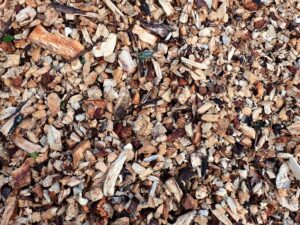
Woodchips are small- to medium-sized pieces of wood formed by cutting or chipping larger pieces of wood such as trees, branches, logging residues, stumps, roots, and wood waste.
Woodchips, with hand for scale
Woodchips may be used as a biomass solid fuel and are raw material for producing wood pulp. They may also be used as an organic mulch in gardening, landscaping, and ecosystem restoration; in bioreactors for denitrification; and as a substrate for mushroom cultivation.
The process of making woodchips is called wood chipping and is done using a wood chipper. The types of woodchips formed following chipping is dependent on the type of wood chipper used and the material from which they are made. Woodchip varieties include: forest chips (from forested areas), wood residue chips (from untreated wood residues, recycled wood and off-cuts), sawing residue chips (from sawmill residues), and short rotation forestry chips (from energy crops).
Raw materials
The raw materials of woodchips can be pulpwood, waste wood, and residual wood from agriculture, landscaping, logging, and sawmills. Woodchips can also be produced from remaining forestry materials including tree crowns, branches, unsaleable materials or undersized trees.
Wood chipper
Forestry operations provide the raw materials needed for woodchip production. Almost any tree can be converted into woodchips, however, the type and quality of the wood used to produce woodchips depends largely on the market. Softwood species, for instance, tend to be more versatile for use as woodchips than hardwood species because they are less dense and faster growing.
Production
A wood chipper is a machine used for cutting wood into smaller pieces (chips). There are several types of wood chippers, each having a different use depending on the type of processing the woodchips will undergo.
Pulp and paper industry
Woodchips used for chemical pulp must be relatively uniform in size and free of bark. The optimum size varies with the wood species. It is important to avoid damage to the wood fibers as this is important for the pulp properties. For round wood it is most common to use disk chippers. A typical size of the disk is 2.0–3.5 m in diameter, 10–25 cm in thickness and weight is up to 30 tons. The disk is fitted with 4 to 16 knives and driven with motors of ½ –2 MW. Drum chippers are normally used for wood residuals from saw mills or other wood industry.
Methods of conveyance
There are four potential methods to move woodchips: pneumatic, conveyor belt, hopper with direct chute, and batch system (manual conveyance).
Types of wood chippers
Disk
A disk wood chipper features a flywheel made of steel and chopping blades with slotted disks. The blades slice through the wood as the material is fed through the chute. Knives located in the throat of the chipper cuts the wood in the opposite direction. The design is not as energy efficient as other styles but produces consistent shapes and sizes of woodchips.
Drum
A drum wood chipper has a rotating parallel-sided drum attached to the engine with reinforced steel blades attached in a horizontal direction. Wood is drawn into the chute by gravity and the rotation of the drum where it is broken up by the steel blades. The drum type is noisy and creates large uneven chips but are more energy efficient than the disk type.
Screw-type
A screw-type wood chipper contains a conical, screw-shaped blade. The blade rotation is set parallel to the opening so wood is pulled into the chipper by the spiral motion. Screw-type, also called high-torque rollers, are popular for residential use due to being quiet, easy to use and safer than disk and drum types.
Applications
Woodchips are used primarily as a raw material for technical wood processing. In industry, processing of bark chips is often separated after peeling the logs due to different chemical properties.
Wood pulp
Only the heartwood and sapwood are useful for making pulp. Bark contains relatively few useful fibers and is removed and used as fuel to provide steam for use in the pulp mill. Most pulping processes require that the wood be chipped and screened to provide uniform sized chips.
Mulch
Woodchips are also used as landscaping and garden mulch, for water conservation, weed control, and reducing and preventing soil erosion. Woodchips when used as a mulch are at least three inches thick. It has a mixed reputation in gardening.
It has been promoted for use in habitat restoration projects. As the radial chipped wood decomposes it improves the soil structure, permeability, bioactivity, and nutrient availability of the soil.
Playground surfacing
Woodchips do not meet American Society for Testing and Materials standards for use as playground surfacing material, and as of 2011 are illegal to use as playground surfacing in the US, not being ADA-approved according to US department of Justice guidelines.
Barbecuing
Woodchips can also be used to infuse flavor and enhance the smoky taste to barbecued meats and vegetables. Several different species of wood can be used depending on the type of flavor wanted. For a mild, sweet fruity flavor, apple wood can be used while hickory gives a smoky, bacon-like flavor. Other different types of wood used are cherry, mesquite and pecan.
Denitrifying woodchip bioreactor
Woodchips can be loaded into a ‘denitrifying woodchip bioreactor’ which has been used for several decades as an emerging biotechnology to treat agricultural wastewater by removing nitrates. It is a subsurface system where denitrification by micro-organisms utilizing a carbon source (as electron donor) reduces the nitrate into a harmless nitrogen gas. Denitrifying woodchip bioreactor have a low construction and operational costs with a comparatively long lifespan going up to 15 years. The interest in such a technique has grown in recent years and has expanded into the mining industry.
A 2013 experiment showed that after 70 days of startup, a woodchip pile loaded with liquid pig manure at 5 L/m2/day removed an average of 90% of nitrate after one month. However, if the environmental conditions do not support complete denitrification, undesirable greenhouse gas such as nitrous oxide gas and methane could be produced.
Fuel
Woody chips left for drying before transport to industrial off-takers in Namibia. Woodchips have been traditionally used as solid fuel for space heating or in energy plants to generate electric power from renewable energy. The main source of forest chips in Europe and in most of the countries [which?] have been logging residues. It is expected that the shares of stumps and round wood will increase in the future. As of 2013 in the EU, the estimates for biomass potential for energy, available under current 2018 conditions including sustainable use of the forest as well as providing wood to the traditional forest sectors, are: 277 million m3, for above ground biomass and 585 million m3 for total biomass.
The newer fuel systems for heating use either woodchips or wood pellets. The advantage of woodchips is cost, the advantage of wood pellets is the controlled fuel value. The use of woodchips in automated heating systems, is based on a robust technology.
The size of the woodchips, moisture content, and the raw material from which the chips are made are particularly important when burning wood chips in small plants. Unfortunately, there are not many standards to decide the fractions of woodchip.
The energy content in one cubic meter is normally higher than in one cubic meter wood logs, but can vary greatly depending on moisture. The moisture is decided by the handling of the raw material. If the trees are taken down in the winter and left to dry for the summer (with teas in the bark and covered so rain can’t reach to them), and is then chipped in the fall, the wood chips’ moisture content will be approximately 20–25%. The energy content, then, is approximately 3.5–4.5kWh/kg (~150–250 kg/cubic meter).
Coal power plants have been converted to run on woodchips, which is fairly straightforward to do, since they both use an identical steam turbine heat engine, and the cost of woodchip fuel is comparable to coal.
Solid biomass is an attractive fuel for addressing the concerns of the energy crisis and climate change, since the fuel is affordable, widely available, close to carbon neutral and thus climate-neutral in terms of carbon dioxide (CO2), since in the ideal case only the carbon dioxide which was drawn in during the tree’s growth and stored in the wood is released into the atmosphere again.
Waste and emissions
Compared to the solid waste disposal problems of coal and nuclear fuels, woodchip fuel’s waste disposal problems are less grave; in a study from 2001 fly ash from woodchip combustion had 28.6 mg cadmium/kg dry matter. Compared to fly ash from burning of straw, cadmium was bound more heavily, with only small amounts of cadmium leached. It was speculated as a form of cadmium oxide, cadmium silicate (CdSiO3); authors noted that adding it to agricultural or forest soils in the long-term could cause a problem with accumulation of cadmium.
Like coal, wood combustion is a known source of mercury emissions, particularly in northern climates during winter. The mercury is both gaseous as elemental mercury (especially when wood pellets are burned) or mercury oxide, and solid PM2.5 particulate matter when untreated wood is used.
When wood burning is used for space heating, indoor emissions of 1, 3-butadiene, benzene, formaldehyde and acetaldehyde, which are suspected or known carcinogenic compounds, are elevated. The cancer risk from these after exposure to wood smoke is estimated to be low in developed countries.
Certain techniques for burning woodchips result in the production of bio char – effectively charcoal – which can be either utilized as charcoal, or returned to the soil, since wood ash can be used as a mineral-rich plant fertilizer. The latter method can result in an effectively carbon-negative system, as well as acting as a very effective soil conditioner, enhancing water and nutrient retention in poor soils.
[geocentric_weather id="c8ab5a88-5d45-4d53-8d8e-0e6c140cb34d"]
[geocentric_about id="c8ab5a88-5d45-4d53-8d8e-0e6c140cb34d"]
[geocentric_neighborhoods id="c8ab5a88-5d45-4d53-8d8e-0e6c140cb34d"]
[geocentric_thingstodo id="c8ab5a88-5d45-4d53-8d8e-0e6c140cb34d"]
[geocentric_busstops id="c8ab5a88-5d45-4d53-8d8e-0e6c140cb34d"]
[geocentric_mapembed id="c8ab5a88-5d45-4d53-8d8e-0e6c140cb34d"]
[geocentric_drivingdirections id="c8ab5a88-5d45-4d53-8d8e-0e6c140cb34d"]
[geocentric_reviews id="c8ab5a88-5d45-4d53-8d8e-0e6c140cb34d"]