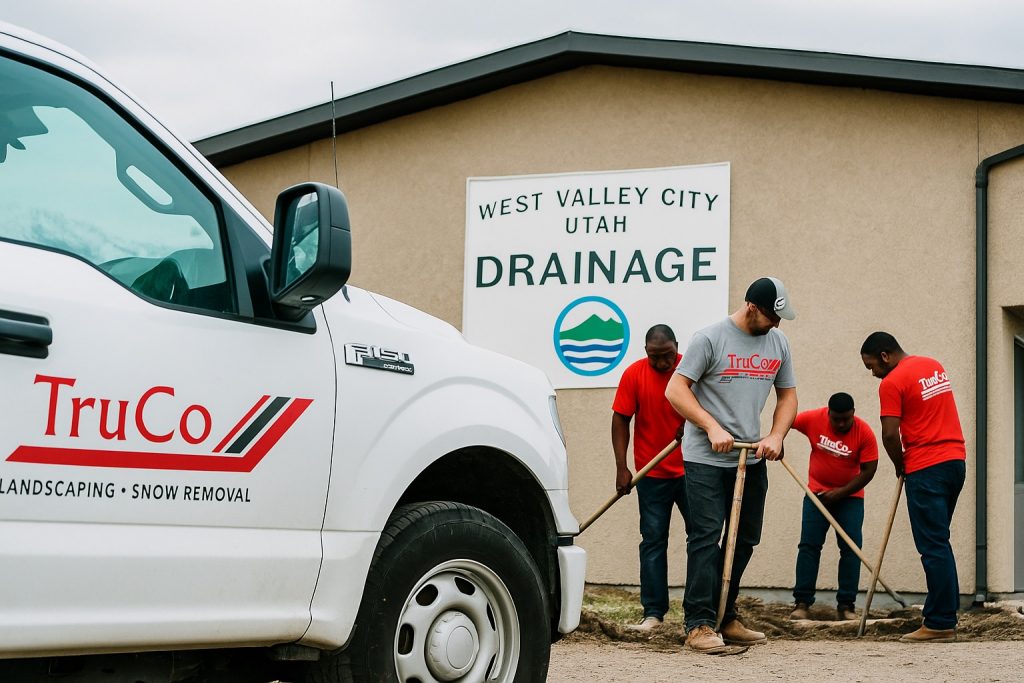
West Valley City Utah Drainage: Protecting Properties Through Smart Water Management
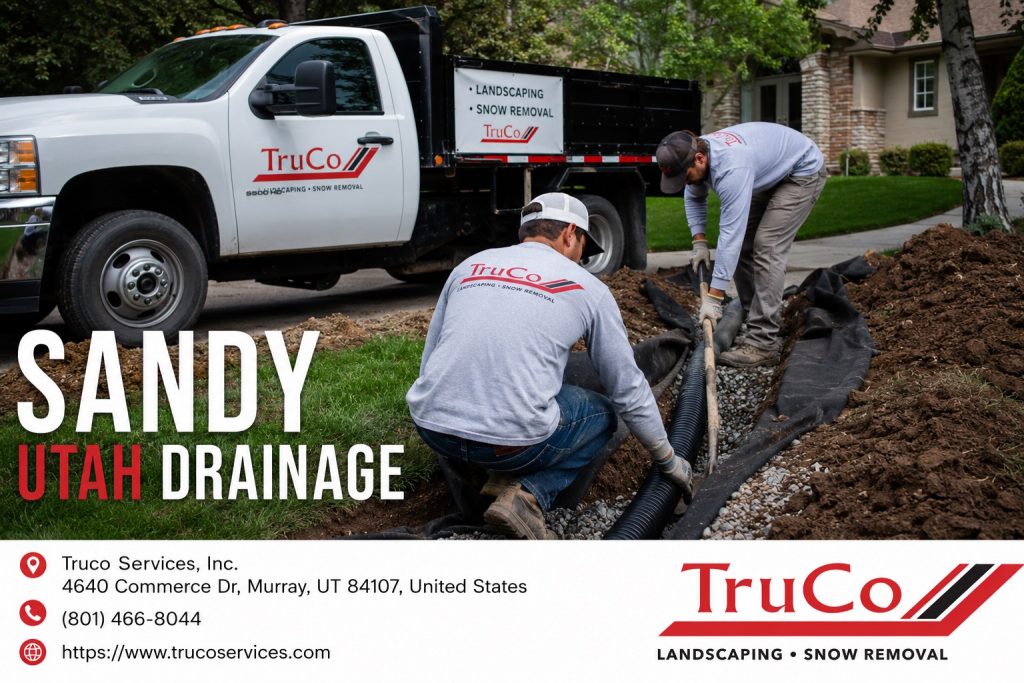
Managing drainage in West Valley City, Utah, is about much more than just keeping surfaces dry — it’s about protecting property investments, preventing water-related damage, and improving the livability of both residential and commercial spaces. With Utah’s unique weather patterns and clay-heavy soil composition, effective drainage systems are essential for homes, businesses, and landscapes alike. TruCo Services, one of Utah’s most trusted landscaping and maintenance companies, provides professional drainage solutions designed to safeguard your property year-round.
Understanding Drainage Challenges in West Valley City
West Valley City sits in the Salt Lake Valley, an area that experiences both intense summer storms and heavy winter snowfall. These conditions can lead to pooling water, foundation damage, and soil erosion if not properly addressed. The combination of hard clay soil and occasional flash flooding makes residential and commercial drainage a critical aspect of any landscape plan.
Without appropriate drainage:
Water can accumulate around foundations, weakening structures and leading to costly repairs.
Poor yard drainage results in standing water, which can kill plants and promote mosquito breeding.
Commercial landscapes may suffer from sinkholes or surface erosion if not maintained correctly.
Why proper Drainage Matters
Good drainage safeguards the structural integrity of your property and maintains aesthetic appeal. A well-designed system helps:
Prevent soil erosion and property damage.
Move excess water away from lawns, pathways, and structures.
Protect irrigation systems and ensure even lawn health.
Improve safety by reducing frozen puddles and slippery surfaces in winter.
When managed properly, it also enhances the long-term health of your plants and turf, preventing root rot and nutrient depletion caused by suffocating soils.
Common Drainage Solutions for Utah Properties
TruCo Services offers several approaches to drainage management, each designed for different property needs and water flow conditions.
1. French Drains:
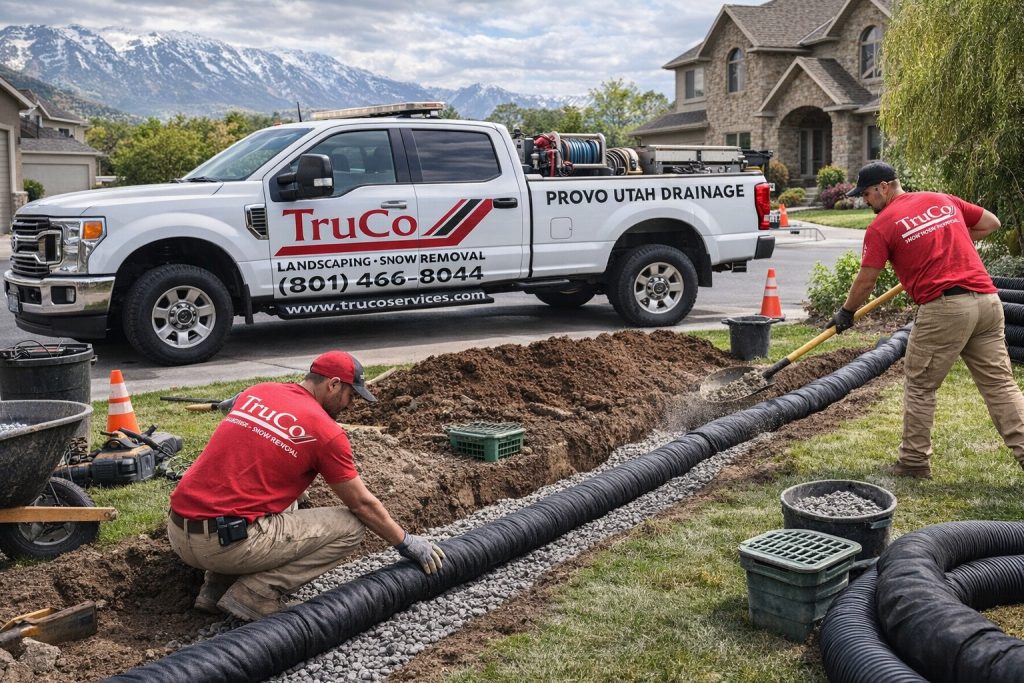
An underground system using perforated pipes wrapped in gravel or rock. These are ideal for diverting surface and groundwater away from homes and landscaped areas.
2. Catch Basins and Channel Drains:
These surface-level systems collect and redirect stormwater effectively — especially in driveways, parking lots, and flat commercial areas.
3. Dry Wells:
Used to collect runoff water and allow it to slowly filter back into the ground, minimizing flooding on larger properties.
4. Surface Grading:
Re-contouring landscape elevations to promote proper water flow toward drains or away from foundational structures.
5. Retaining Wall Drains:
Retaining walls play a vital role in West Valley’s varied terrain, and built-in weep holes or behind-wall drains can prevent water pressure and soil collapse.
The Impact of Utah Weather on Drainage
Utah’s four distinct seasons require drainage systems that can adapt to changing conditions:
Winter: Heavy snow leads to excessive water runoff during thaw periods.
Spring: Ground saturation from melting snow can overwhelm inadequate drainage.
Summer: Intense storms may cause flash floods due to dry, compacted soil resisting absorption.
Fall: Clogged gutters with falling leaves can disrupt flow and cause localized flooding.
This cyclical moisture pattern puts a strain on poorly designed or outdated systems. TruCo Services ensures that every project accounts for these factors, designing installations that are durable, adaptable, and tailored to long-term performance.
How TruCo Services Protects Your Property
TruCo Services stands out for its holistic approach to landscaping and water management. As a full-service landscaping and snow removal company, the team integrates drainage solutions seamlessly with other outdoor systems.
Their professionals include:
Licensed irrigation technicians who understand how water distribution affects ground health.
Certified arborists ensuring tree health isn’t compromised by flooding or erosion.
Skilled landscapers capable of improving both functionality and visual appeal.
This combined expertise allows TruCo to deliver custom drainage designs that serve both form and function. Whether for a sprawling commercial property or a private residence, each project follows strict standards of efficiency, safety, and quality.
Drainage and Snow Management: A Crucial Partnership
In West Valley City, drainage design must also consider snow removal practices. When snow piles melt, the resulting water runoff can lead to flooding around driveways and structures if the drainage is inadequate. TruCo Services handles both aspects — snow removal and drainage — ensuring that properties remain functional regardless of weather extremes.
Their winter management services integrate with their drainage planning, providing seamless solutions that minimize ice buildup, protect pavements, and prevent water-related surface damage.
Commercial Drainage Management for West Valley Businesses
For business owners, drainage problems can mean more than just inconvenience — they can disrupt operations and deter customers. Standing water in parking lots, eroded walkways, and foundation cracks create safety hazards and liability concerns.
TruCo Services specializes in commercial installation, meaning they’re equipped to handle drainage for:
Office complexes
Retail centers
Industrial properties
Apartment communities
Using a combination of surface and subsurface systems, TruCo ensures businesses enjoy clean, safe, and flood-resistant exteriors throughout the year.
Sustainable and Eco-Friendly Drainage Design
Proper drainage is not just a maintenance task — it’s an opportunity to conserve water and protect Utah’s natural ecosystem. TruCo employs sustainable techniques, including:
Permeable hardscapes that allow water to infiltrate naturally.
Rain gardens and native plant installations to manage runoff while enhancing beauty.
Smart irrigation integration that ensures water is used efficiently across landscaping zones.
These green methods align with Utah’s growing environmental initiatives and offer long-term savings through reduced water waste and repair costs.
Why Choose TruCo Services
TruCo Services combines technical expertise with a deep commitment to client satisfaction. The company’s reputation is built on:
Long-lasting drainage designs that adapt to Utah’s seasons.
Clients can count on TruCo not only to install drainage systems but to maintain them, ensuring each solution continues to perform at its best.
Keeping Your Property Safe Year-Round
From snowmelt runoff to heavy rainstorms, your property’s drainage system is the first line of defense against water damage. TruCo Services offers complete solutions that combine installation, maintenance, and environmental awareness, giving property owners peace of mind.
Every step — from site assessment to final inspection — is handled with precision and care. Whether you’re upgrading your current system or building a new one, TruCo ensures that your property remains protected, attractive, and sustainable.
Contact TruCo Services Today
Don’t wait until the next storm to see the importance of proper drainage. Secure your property’s foundation, preserve your landscaping investments, and ensure peace of mind with TruCo’s expert team.
Call today at (801) 466–8044 or visit https://www.trucoservices.com to schedule a consultation or request a professional drainage assessment in West Valley City, Utah.
Salt Lake City Utah Drainage
Salt Lake City Utah Drainage: Comprehensive Guide to Protecting Your Landscape and Property
When it comes to maintaining a thriving landscape in Salt Lake City, Utah, drainage is one of the most overlooked yet critical elements. Proper drainage ensures that your outdoor spaces remain beautiful, functional, and structurally sound, while improper drainage can lead to widespread damage that affects your home’s foundation, your yard’s health, and even the safety of your property.
If you’re searching for professional Salt Lake City Utah drainage solutions, this guide will explain everything you need to know—from common drainage problems and solutions to why working with Truco Services is your best choice.
Why Drainage Is Important in Salt Lake City, Utah
Salt Lake City’s unique climate and geography mean that proper drainage systems are not just an option—they are essential. With hot, dry summers and cold winters that bring freezing conditions and snow melt, drainage systems serve as a safeguard for your property. Here’s why:
Prevents Foundation Damage
Improper water flow can pool around your home’s foundation. Over time, this can cause cracks, shifting, and costly structural issues.
Protects Landscaping Investments
Waterlogged soil suffocates plants, trees, and grass by depriving their roots of oxygen. A proper drainage system ensures that your landscaping thrives rather than drowns.
Eliminates Flooding Risk
Heavy rains or rapid snow melt can lead to basement flooding or yard pooling. Once water enters your home, repairs can cost tens of thousands of dollars.
Guards Against Soil Erosion
Slopes and hillsides in Salt Lake City are particularly prone to erosion if water is not redirected properly. Erosion not only damages landscaping but also destabilizes trees and shrubs.
Improves Property Value
Homes with well-maintained landscapes and solid drainage systems hold stronger market value. Future buyers see drainage as a sign of quality upkeep and reduced risk.
Common Drainage Problems in Salt Lake City
Homeowners in Salt Lake City face specific drainage problems due to a combination of elevation changes, clay-heavy soils, and extreme weather changes. Below are the most frequent issues homeowners encounter:
Standing Water in the Yard: Usually caused by compacted soil or improper grading.
Basement or Crawl Space Moisture: Often linked to poor gutter systems or failed French drains.
Erosion on Slopes or Hills: Caused by unchecked water runoff.
Water Damaging Driveways and Walkways: Runoff that is not properly directed can crack and destabilize concrete or asphalt over time.
Gutter Overflow Problems: Clogged or improperly positioned gutters can worsen yard flooding.
Soggy Lawns After Rainfall: Indicates poor soil drainage or lack of a subsurface drainage system.
Addressing these problems as early as possible not only saves you money but also prevents long-term property destruction.
Effective Drainage Solutions
The good news is that nearly every drainage problem has a solution when you trust the right professionals. Here are proven drainage strategies that companies like Truco Services utilize for Salt Lake City properties:
1. French Drains
A French drain is a trench filled with gravel or rock that contains a perforated pipe. It redirects surface and groundwater away from your home or yard, effectively preventing pooling and basement leakage.
2. Dry Wells
Dry wells provide a place for excess water to collect before slowly percolating back into the ground. They are excellent for managing heavy stormwater.
3. Catch Basins and Channel Drains
Ideal for properties with paved driveways or patios, these systems collect and redirect surface water before it can flood low areas.
4. Downspout Extensions
One of the simplest yet most effective solutions is rerouting gutter water away from the foundation with extensions.
5. Regrading / Yard Leveling
If your yard slopes toward your home instead of away, professional regrading ensures water flows away from your property instead of pooling around structures.
6. Retaining Walls with Drainage Systems
For properties on hills or inclines, retaining walls paired with proper drainage (such as weep holes and gravel backfill) prevent erosion and soil displacement.
7. Sump Pumps
For basements vulnerable to flooding, sump pump systems automatically remove water and keep your lower levels dry.
8. Permeable Pavers
Driveways and patios built with permeable pavers reduce runoff and improve drainage naturally.
Each yard and home in Salt Lake City is unique, which is why it’s critical to consult with drainage experts like Truco Services for custom evaluation and installation.
Why Choose Truco Services for Salt Lake City Drainage
When it comes to Salt Lake City Utah drainage solutions, one name stands out: Truco Services. With decades of experience in tree care, landscaping, and drainage management, they bring a unique combination of expertise to every project. Here’s why you should call them today:
1. Local Knowledge & Expertise
Truco Services understands the specific soil conditions, climate challenges, and topographical issues that Salt Lake City homeowners face. Their solutions are designed for Utah’s environment—not just generic drainage fixes.
2. Full-Service Approach
Unlike many contractors who only handle one aspect of drainage, Truco Services provides a complete package that integrates tree health, landscaping, and drainage. This ensures that both your yard and your structures remain functional and beautiful.
3. Preventative Focus
They believe in solving the root of the problem rather than quick, temporary fixes. By designing long-lasting drainage systems, they save you money and stress in the long term.
4. Trusted Reputation
Thousands of property owners across Utah trust Truco Services for their outdoor needs, whether it’s tree care, stump grinding, landscaping, or drainage. Their reputation is built on reliability, honesty, and proven results.
5. Customized Drainage Design
No two yards are alike. Truco Services evaluates each property carefully to design unique drainage systems that function seamlessly with your landscape layout.
6. Affordable & Transparent Pricing
Drainage systems are an investment, but with Truco Services, you’ll always know your costs upfront. They offer competitive rates without sacrificing quality.
7. Customer-Centered Service
From the initial consultation to project completion, their team prioritizes clear communication, responsive service, and your satisfaction.
Warning Signs That You Need Professional Drainage Help
If you notice any of the following issues on your Salt Lake City property, it’s time to schedule a drainage inspection with Truco Services:
Water pooling in your yard for more than 24 hours after rain
Cracks forming in your home’s foundation or basement walls
Mold, mildew, or damp smells in your basement or crawl space
Yellowing or dying grass in specific areas of your yard
Significant soil displacement after storms
Water stains or rust near foundation walls
Driveway or patio cracks caused by shifting soil underneath
Ignoring these warning signs could lead to thousands of dollars in damage. Truco Services offers fast, professional evaluations to protect your property before problems get worse.
Truco Services: Your Local Experts in Drainage
With Salt Lake City Utah drainage, you need a professional partner that understands the critical balance between soil, water flow, and landscaping. Truco Services excels at creating customized drainage plans that protect your investment while enhancing curb appeal.
When you invest in a drainage system through Truco Services, you gain peace of mind knowing that:
Your home’s foundation is safeguarded against water damage.
Your landscape remains healthy, vibrant, and erosion-free.
You’re preventing flooding and structural issues for the long term.
Your property’s value increases with a sustainable drainage solution.
Call Truco Services Today
Don’t wait until standing water turns into foundation cracks or basement flooding. Whether you need a French drain, yard regrading, sump pump installation, or complete drainage redesign, Truco Services is the trusted local expert in Salt Lake City, Utah.
Let Truco Services design a drainage system that keeps your property dry, safe, and beautiful year-round.
Final Thoughts
Salt Lake City Utah drainage problems can quickly escalate if left untreated. From costly foundation damage to ruined landscaping, the consequences are serious—but with proactive solutions, they’re entirely preventable. Truco Services provides the experience, tools, and knowledge necessary to address drainage issues the right way the first time.
By choosing Truco Services, you’re investing in long-term protection for your property, increased home value, and a healthier outdoor environment. For peace of mind and professional results, there’s no better choice.
👉 If you’re experiencing drainage problems or simply want to protect your property before they arise, call Truco Services today at (801) 466-8044 or visit https://truetreeservices.com/ to schedule your consultation.
THE DANGERS OF NOT REMOVING DEAD TREES NEAR PUBLIC PATHS AND TRAILS
Not removing dead trees near public paths and trails can pose significant dangers to both the public and the surrounding environment. Here are some of the key dangers associated with leaving dead trees in these areas:
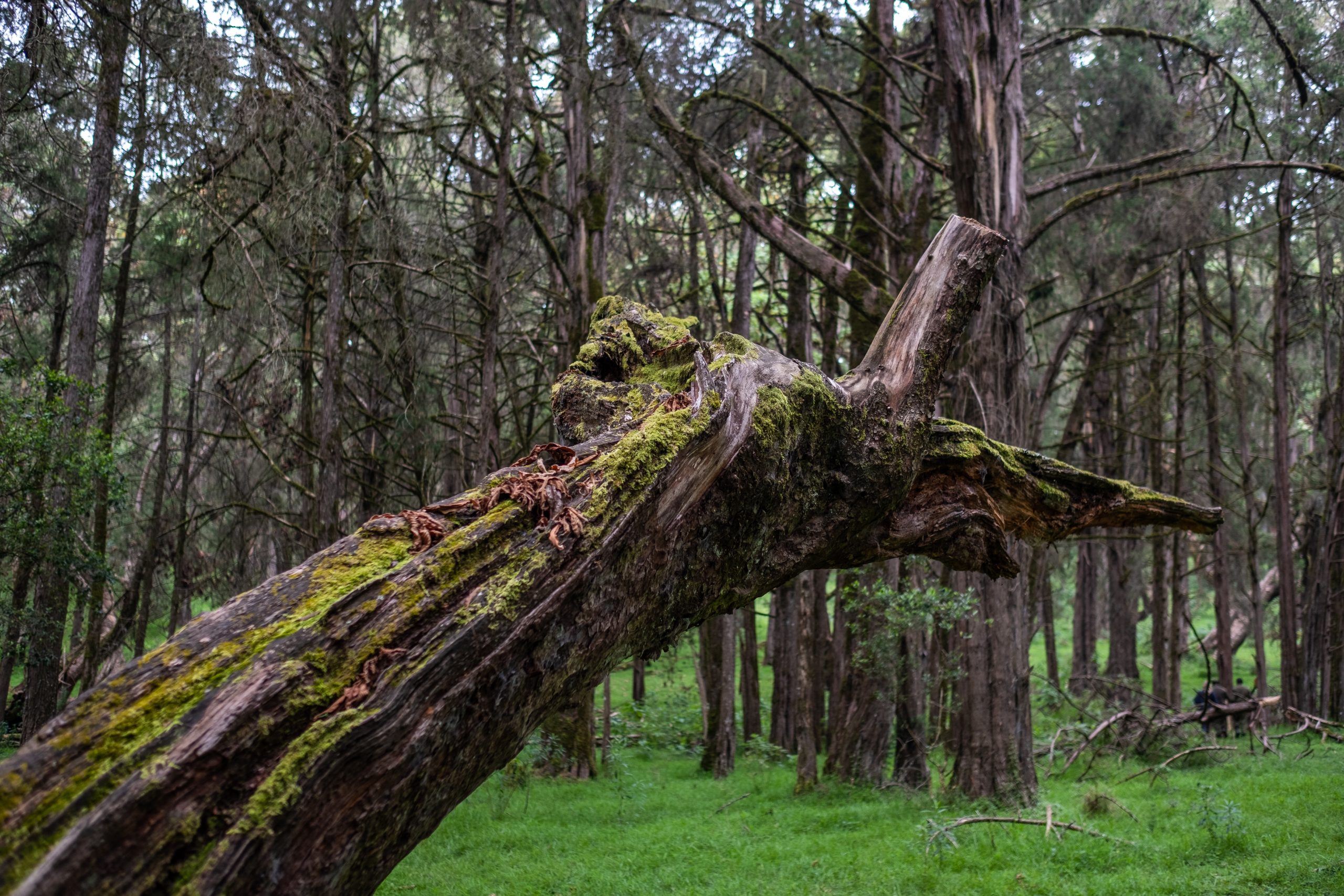
Safety Hazards: Dead trees are at risk of falling, especially during storms or high winds. These falling trees or branches can cause serious injuries or even fatalities to people using the paths and trails. Public safety is a primary concern, and dead trees near high-traffic areas can present an immediate risk.
Liability Issues: If a dead tree falls and causes harm to a person or property, the entity responsible for managing the public paths and trails may be held liable for damages. Removing dead trees proactively helps mitigate this potential liability.
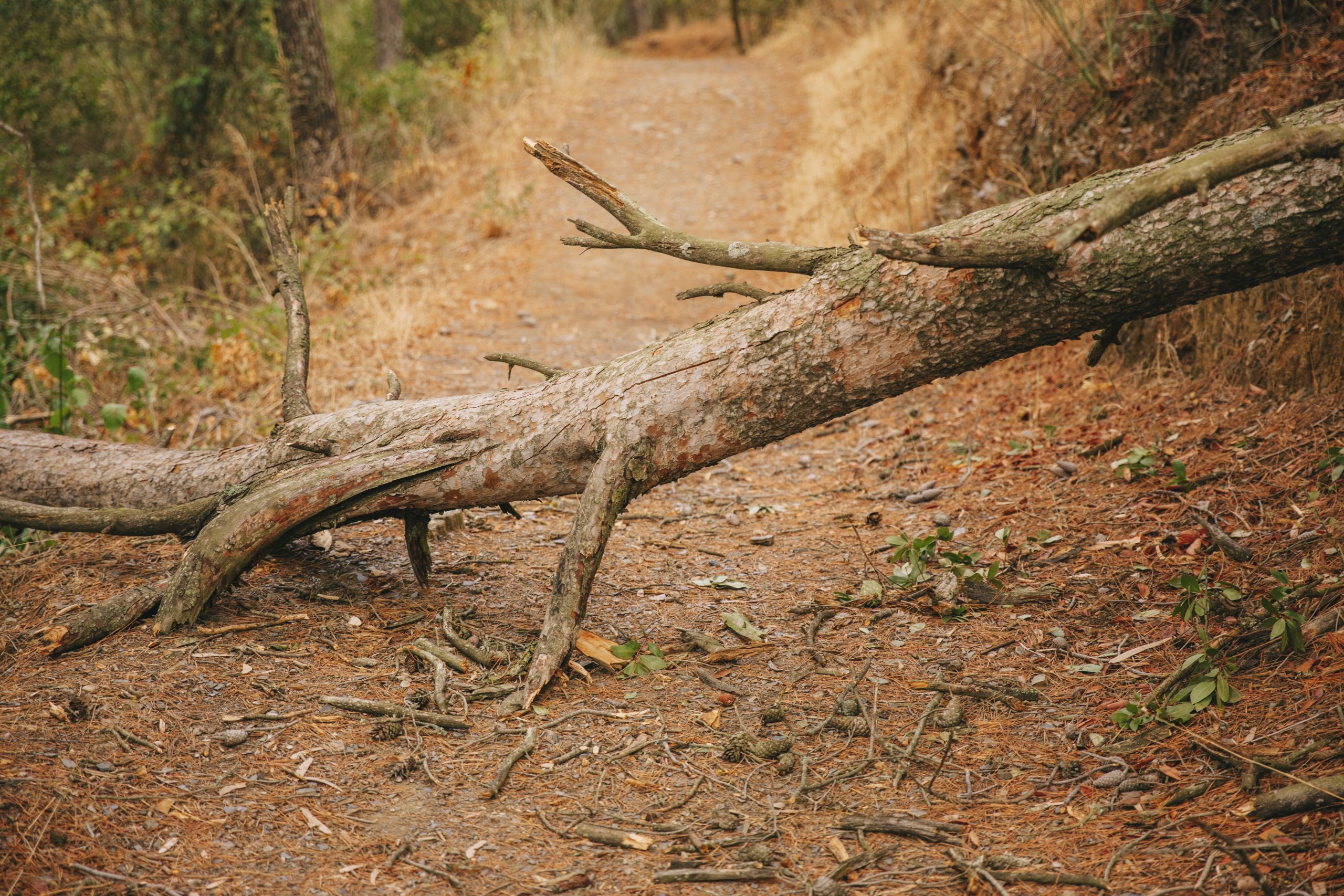
Trail Accessibility: Fallen or dead trees can obstruct paths and trails, making them impassable and inconvenient for users. This can lead to reduced access and dissatisfaction among trail users.
Environmental Impact: Dead trees can serve as a breeding ground for pests, pathogens, and fungi that may spread to healthy trees nearby. If not removed, the infestation can spread, affecting the overall health of the forest or ecosystem.
Fire Hazards: Dead trees are often dry and can become fuel for wildfires. Leaving dead trees near public paths and trails increases the risk of fire incidents, especially in regions prone to wildfires.
Aesthetic Value: Dead trees can negatively affect the aesthetics and beauty of public paths and trails. Visitors may be discouraged from using the trails if they perceive them as poorly maintained or unsafe.
Ecological Balance: Dead trees provide habitat and food sources for various wildlife species. However, when dead trees are excessively concentrated near public paths and trails, it can disrupt the ecological balance, leading to potential overpopulation of certain species or imbalances in the ecosystem.
To address these dangers, it’s essential to implement regular tree inspections along public paths and trails. Dead or hazardous trees should be identified and promptly removed by qualified tree care professionals to ensure public safety and maintain the integrity of the environment.
Planting new trees to replace the ones removed, contributing to the sustainability and aesthetics of the area.
Creating buffer zones or barriers to prevent dead trees from falling onto the trails or other sensitive areas.
By proactively managing dead trees near public paths and trails, communities can create safer and more enjoyable outdoor spaces for the public to enjoy while also preserving the health and balance of the natural environment.
Though people hate in general to lose any type of tree, there are just some instances when completely removing them cannot be avoided. Even just the thought of completely removing trees can bring sadness and tears to many people, whether they are die-hard nature-lovers or not. Of course, there are other ways wherein they can be still helped to grow healthily, such as pruning and trimming and trees also usually benefit from some fumigation. And the last and most drastic option, when there really is no other sound and safe reason to keep the tree around, is to remove it.
Below are the main and most common valid and acceptable reasons why trees have to be cut down or properly removed:
If the tree is dead or its disease/s can no longer be treated or cured.
All people love to look at healthy and lush trees. But the ones that are dead or suffering from some diseases are pretty disheartening to look at. Dead trees are also usually serious safety hazards and can be a source of many accidents so people often decide to just have them removed.
Wrong tree type at a poor location.
Some trees can be a threat when they are rooted in areas of high pedestrian and/or vehicular traffic. One particular tree is the Eucalyptus, which always have the tendency to lose or drop big branches frequently. Of course, cutting them down is not always the immediate option; if they are still very healthy, they can be removed and transplanted to a different area where they cannot cause any problems or danger with the help of local professional arborists or some tree surgeons.
When a tree has become a refuge and breeding ground for big and small pests.
Dead and healthy trees can become the home of unwanted and disease-carrying pests, such as rodents and ants. Bees and wasps, which can be very dangerous insects, also tend to nest or build their hives in trees. And if people are very particular about the safety and security at their properties, especially if they are concerned about their children, then they do have a valid reason for removing them.
Trees, in addition to being wonderful and beautiful natural structures that everyone should nourish and cherish, also provide many benefits to all humans, living creatures, and the environment in general. But it is also important to look at the big picture, too. When trees have to be removed, harboring any doubts or misgivings about this course of action will not serve to help anyone. After all, your safety and good health, and your loved ones’ as well, are also important and should be your top priority.
You don’t know how it happened, but it did – you’ve got a dead tree on your hands. If you want to preserve the lush look of your landscape, then it’s time to consider hiring a tree removal service. Perhaps your majestic oak is posing a major danger for drivers, as it’s starting to lean out onto the road, or your tree is causing some serious damage to your roof – and it needs to go now.
While homeowners should consider tree removal a last-option, you’ll need to give your local tree service a call if:
A tree is causing structural damage to your home;
It’s causing a safety or navigational hazard.
Your tree has kicked the bucket. If the tree hasn’t blossomed or had fresh growth in over a year, it’s highly likely that it’s dead. Break off a small branch to see – is it brittle? Are the insides dry? If so, then it’s time to call a tree removal service.
Worried that this unexpected expense will break your bank account? While you can get a free estimate from most tree removal companies, you can use the following factors to estimate just how much it will cost to remove your troublesome tree:
The location of the tree can have a significant impact on the total cost of removal. For example, how easy is it for the tree removal company to get to the tree? Is it located near your house or near the road? Is it safe to remove, or will the arborist in question need to deal with utility wires and other dangerous obstacles? Additionally, will the tree removal have an impact on your neighbor’s property?
The size and location of the tree will have the biggest impact on the total price of your tree removal.
The health of the tree will also have an impact on the price of your project. Expect dead, dying or diseased trees to potentially cost more to remove (because of the danger and skill needed to address the removal), while healthier trees will be easier on your piggy bank. Periodic evaluation of your trees and plants could save you thousands of dollars in repairs and or replacements. It will in fact add thousand of dollars of value to your home by adding beauty to your landscape.
You should expect when speaking with a professional tree service provider, that they will outline for you the specific cost for specific work to be done. Cost for tree removals, tree trimming, stump grinding, and other specialized services not limited to hauling and fertilization should be clearly outlined in a proposal for work.
While tree removal can be an unexpected cost, knowing what you’ll be charged for can make all the difference between a surprise invoice and an expense you’re prepared for. If you really want an exact figure for your tree removal, ask local companies for a free tree estimate. You will find that the frequent analysis of your trees will pay off, when you save large sums of cash for addressing dead or dying trees.
Tips To Maintaining Garden Trees
Few people may realize that tall ones in the garden need constant, responsible and specialized care. If not properly monitored and regularly pruned, they may quickly grow out of control and not only become unsightly, but also pose a potential danger to family, neighbors and property. For example dead ones, or trees with large dead branches that are allowed to rot, will eventually tear off or fall over (usually in high winds and storms) and can damage overhead power lines, neighbors’ fences or property, and, in the worst scenario, people.
Here are some of the basic maintenance rules for mature garden trees:
Structural Pruning of Young Trees
Structural pruning when they are young is an important elementary step to proper and proactive tree maintenance. May of the problems trees develop in later years could have been easily avoided if properly pruned and shaped when young. Pruning in young ones also encourages healthy branch formation and will require far less maintenance in the long run. For example, when pruning, many future problems can be avoided by cutting away weak branches, or directing growth away from potential future hazards such as buildings.
Maintaining Mature Trees
When pruning or shaping mature plants, there are a number of aspects to consider. For example, the species of tree, its growth habits, its situation, the time of season, and its age. Mature plants are not as responsive to pruning as young ones. When in doubt, it may be best to consult with a professional arborist to ensure that the tree is preserved rather than damaged while ensuring safety and proper health.
Removing Dead Trees
It is always a source of regret when a mature tree needs to be cut down or removed. But very often this becomes a necessity when it poses a threat to property, or parts of it have died, or the tree is dead altogether. Anyone without proper knowledge, equipment or expertise should not attempt to cut down or remove mature trees themselves. This is definitely a job for specialists, as some large ones can be extremely risky to remove (especially in urban areas) due to their proximity to people, power lines and property. Very often cranes have to be used in the case of dangerous tree removals.
If you need a tree service in Utah, you can call: Truco Services, Inc. 4640 Commerce Drive Murray, Utah 84107 (801) 466-8044 https://truetreeservices.com/
BEST PRACTICES FOR MANAGING TREE ROOTS NEAR BUILDINGS AND INFRASTRUCTURE
Managing tree roots in urban environments is crucial to ensure the health of both trees and the urban infrastructure. Urban areas pose unique challenges to trees due to limited space, competition for resources, and the presence of buildings, roads, and utilities. Effective root management is essential to create a harmonious balance between the benefits of urban trees and the requirements of a functional urban landscape. Here’s why managing tree roots in urban environments is important:
Tree Health and Longevity
Proper root management supports healthy root growth and prevents damage.
Healthy roots contribute to overall tree vigor, growth, and longevity.
Managing root space ensures that trees can access sufficient water, nutrients, and oxygen for optimal growth.
Infrastructure Protection
Unmanaged tree roots can damage buildings, roads, sidewalks, and underground utilities.
Root intrusion into pipes and utilities can lead to costly repairs and disruptions.
Healthy root systems support tree vitality and the capacity to provide cooling benefits.
Aesthetic and Livability Improvement:
Trees enhance the visual appeal of urban areas and improve overall livability.
Well-maintained trees contribute to a sense of community and well-being.
Air Quality and Biodiversity
Urban trees improve air quality by absorbing pollutants and releasing oxygen.
Managing root health ensures trees can effectively contribute to air quality improvement.
Healthy trees also support urban biodiversity by providing habitats for various species.
Economic Benefits
Urban trees add economic value to properties and neighborhoods.
Trees increase property values, reduce energy costs through shade, and attract businesses and residents.
Climate Resilience
Trees are an essential part of urban climate resilience strategies.
Well-managed trees can withstand weather extremes, reducing vulnerability to climate-related events.
Community Well-Being
Trees provide psychological and health benefits to urban residents.
Access to green spaces and well-maintained trees contributes to mental and physical well-being.
Managing tree roots in urban environments is essential for the coexistence of trees and urban infrastructure. It ensures that trees can thrive and provide numerous benefits while minimizing risks and conflicts. Integrating proper root management into urban planning and development strategies is key to creating sustainable and resilient cities for both people and nature.
Balancing Tree Health and Structural Integrity
Balancing tree health and structural integrity refers to the careful consideration and management of trees in relation to the surrounding built environment. It involves making informed decisions that prioritize both the well-being of trees and the safety of structures, infrastructure, and people. This balance is essential to create harmonious urban landscapes where trees and man-made elements coexist without causing conflicts or hazards. Here’s a deeper explanation of this concept:
Tree Health
Tree health encompasses various factors such as root development, canopy vitality, pest and disease resistance, and overall growth.
Healthy trees have strong root systems, well-structured canopies, and the capacity to perform vital functions like photosynthesis and nutrient absorption.
Proper soil conditions, adequate water availability, and suitable nutrients are crucial for maintaining tree health.
Structural Integrity
Structural integrity refers to the stability and durability of buildings, roads, sidewalks, and other human-made structures.
It involves ensuring that structures are constructed and maintained to withstand the forces of nature, including wind, rain, and soil movement.
Preventing damage to structures helps avoid safety hazards, economic losses, and disruptions.
Challenges of Urban Environments
Urban environments present unique challenges due to limited space, compacted soils, and competition for resources.
Trees in urban areas often have restricted root zones, leading to potential conflicts with infrastructure.
Unmanaged tree roots can damage buildings, roads, utilities, and create tripping hazards on sidewalks.
Importance of Balance
Balancing tree health and structural integrity ensures that trees contribute positively to urban environments without compromising safety and functionality.
It requires collaboration between arborists, urban planners, engineers, and stakeholders to make informed decisions.
Root Management
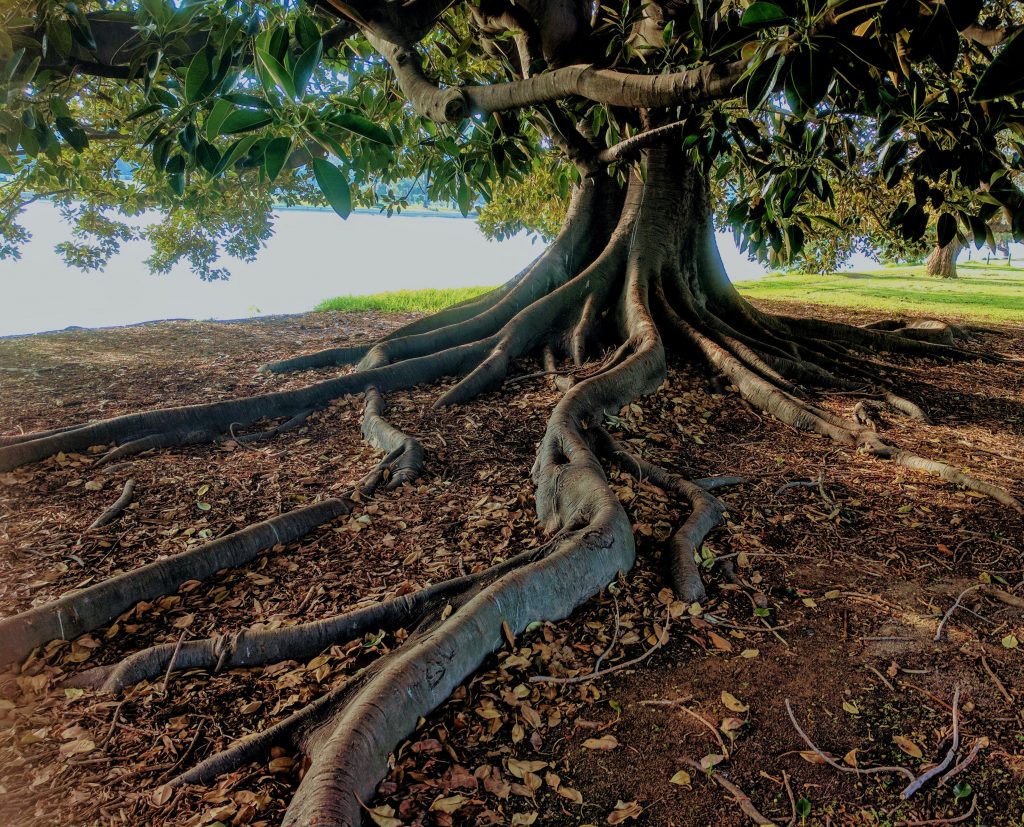
Proper root management techniques, such as root pruning and installation of root barriers, guide root growth away from critical infrastructure.
Pruning techniques aim to preserve tree health and remove branches that pose risks to structures.
Proper pruning minimizes the potential for falling branches that could cause damage or injury.
Tree Selection and Placement
Choosing appropriate tree species based on mature size and growth habits is crucial.
Proper placement of trees away from buildings, utility lines, and other infrastructure prevents conflicts.
Monitoring and Maintenance
Regular monitoring of tree health and structural conditions is essential.
Timely maintenance activities such as pruning and root management prevent conflicts from escalating.
Collaboration and Education
Collaborative efforts between arborists, urban planners, and construction professionals lead to informed decisions.
Educating the public about the importance of responsible tree care and proper planting techniques fosters a culture of balanced management.
Balancing tree health and structural integrity involves integrating tree care practices with urban planning to create safe, attractive, and functional environments. By considering both the needs of trees and the requirements of built structures, cities can achieve a harmonious coexistence that benefits residents, the environment, and future generations.
Site Selection and Planning
Site selection and planning are critical steps in urban tree management to ensure that trees are strategically placed and cared for in a way that benefits both the trees and the surrounding environment. Proper site selection and planning involve evaluating various factors to determine the best locations for planting and managing trees in urban settings. Here’s a detailed explanation of site selection and planning:
Assessment of Existing Conditions
Conduct a thorough assessment of the site’s existing conditions, including soil quality, drainage, sunlight exposure, wind patterns, and microclimates.
Consider factors like proximity to buildings, utilities, roadways, and other infrastructure.
Tree Species Selection
Choose tree species that are well-suited to the site’s conditions, including soil type, moisture levels, and sunlight availability.
Select species with mature sizes that are appropriate for the available space and won’t conflict with infrastructure.
Functional Goals
Define the functional goals of tree planting, such as providing shade, enhancing aesthetics, improving air quality, or managing stormwater runoff.
Design Considerations
Integrate trees into the overall landscape design, taking into account pathways, seating areas, green spaces, and other design elements.
Consider creating tree-lined streets, boulevards, and green corridors to enhance the urban environment.
Utility and Infrastructure Coordination
Coordinate with utility companies to ensure that tree planting locations avoid conflicts with underground utilities.
Plan for proper spacing and clearance to prevent future conflicts as trees grow.
Traffic and Pedestrian Safety:
Consider traffic patterns and pedestrian pathways to ensure that trees don’t obstruct visibility or impede movement.
Plant trees in locations that won’t create hazards for drivers or pedestrians.
Root Space and Soil Volume
Plan for adequate root space and soil volume to support healthy root growth.
Design tree pits or planting areas that allow roots to spread without causing damage to sidewalks or structures.
Future Growth and Maintenance
Anticipate the growth of trees over time and plan for ongoing maintenance needs.
Design spaces that allow for proper pruning, watering, and other maintenance activities.
Involve the community in the site selection and planning process to ensure that the chosen tree species and locations align with local preferences and needs.
Gather input from residents, businesses, and stakeholders to build support for the project.
Long-Term Vision
Consider the long-term impact of tree planting on the urban environment and the benefits that trees will provide for future generations.
In summary, site selection and planning for urban trees involve a comprehensive analysis of site conditions, design considerations, infrastructure coordination, safety, and environmental factors. A well-planned approach ensures that trees thrive, enhance the urban environment, and coexist harmoniously with the surrounding landscape and built structures.
BEST PRACTICES FOR MANAGING TREE DEBRIS NEAR ROADWAYS
Trees play a crucial role in improving soil organic matter decomposition through various scientific mechanisms. Here are some key ways in which trees contribute to this process:
Leaf Litter and Organic Inputs: Trees shed leaves and other organic materials, which contribute to the organic matter content of the soil. These organic inputs, known as leaf litter, contain carbon compounds that serve as a food source for decomposer organisms in the soil.
Rhizodeposition: Trees release organic compounds, such as sugars, amino acids, and organic acids, through their roots. This process, known as rhizodeposition, provides a source of energy and nutrients for soil microorganisms involved in decomposition.
Root Exudates: Tree roots release exudates, including enzymes, organic acids, and other compounds. These exudates facilitate the breakdown of organic matter in the soil, enhancing decomposition processes.
Microbial Activity:Trees support a diverse and active microbial community in the soil. Soil microorganisms, such as bacteria, fungi, and archaea, play a crucial role in decomposing organic matter by secreting enzymes that break down complex organic compounds into simpler forms that can be absorbed by plants.
Soil Aggregation: Trees contribute to the formation of soil aggregates, which are small clusters of soil particles bound together. Soil aggregates create pore spaces that allow for better water infiltration, gas exchange, and movement of decomposer organisms. This facilitates the decomposition process by providing a favorable environment for microbial activity.
Soil Moisture and Temperature Regulation: Trees provide shade and transpire water, creating a more favorable microclimate in the soil. Moderate soil moisture and temperature conditions support optimal microbial activity and decomposition rates.
Mycorrhizal Associations: Many tree species form mutualistic relationships with mycorrhizal fungi. These fungi form a symbiotic association with tree roots, extending the root system and enhancing nutrient uptake. Mycorrhizal fungi also contribute to organic matter decomposition through their enzymatic activities.
Earthworm Activity:Trees, especially those with dense leaf litter, can attract earthworms to the soil. Earthworms feed on decaying organic matter, facilitating its breakdown and nutrient cycling.
By promoting the decomposition of organic matter, trees contribute to the nutrient cycling and fertility of the soil. The organic matter decomposition process releases essential nutrients that become available to plants, supporting their growth and overall ecosystem productivity.
It’s important to note that the specific mechanisms and rates of organic matter decomposition can vary depending on tree species, soil conditions, climate, and other environmental factors. However, the overall contribution of trees to soil organic matter decomposition is well-established and underscores their importance in maintaining healthy and productive ecosystems.
Key Aspects of Emergency Tree Services
Tree Removal: Emergency tree services involve the prompt and safe removal of fallen, leaning, or hazardous trees. Professionals use specialized equipment and techniques to dismantle or cut down trees in a controlled manner, minimizing the risk of damage to surrounding structures.
Storm Damage Response: In the aftermath of severe storms, high winds, hurricanes, or tornadoes, emergency tree services address fallen trees, broken branches, and trees that pose an imminent threat to property or public safety.
Utility Line Clearance: Fallen trees and branches can pose a significant risk to utility lines, including power lines and telephone cables. Emergency tree services involve safely removing trees and debris that are in contact with or near utility lines to prevent power outages, fires, or electrical hazards.
Public Safety: When trees or branches block roadways, pathways, or access points, emergency services are needed to clear the obstruction and restore safe passage for pedestrians and vehicles.
Structural Integrity: If a tree falls onto a building, vehicle, or other structures, emergency tree services assess the situation, stabilize the tree, and carefully remove it to prevent further damage and ensure safety.
Hazardous Tree Identification:Arborists and tree professionals assess the structural integrity and health of trees to identify potential hazards. Trees with compromised structural integrity due to disease, decay, or other factors may be targeted for removal to prevent future emergencies.
Quick Response:Emergency tree services require rapid response to prevent escalation of risks. Professionals are available around the clock to address urgent situations promptly.
Safety Measures: Safety is paramount during emergency tree services. Professionals are equipped with proper personal protective equipment (PPE) and follow safety protocols to avoid accidents and injuries.
Community Support:Emergency tree services often work in collaboration with local authorities, emergency response teams, and utility companies to coordinate efforts and ensure a comprehensive response.
Examples of Emergency Situations
Fallen trees blocking roads or driveways
Trees on the verge of collapsing onto structures or vehicles
Trees leaning dangerously after a storm
Trees entangled in utility lines
Trees with branches that have broken or are at risk of falling
Trees posing risks to public safety in public spaces
Overall, emergency tree services play a critical role in addressing immediate threats posed by trees in distress. Their expertise and rapid response help minimize risks, restore safety, and protect communities from potential hazards associated with fallen or damaged trees.
Importance of addressing tree-related emergencies promptly
Addressing tree-related emergencies promptly is of paramount importance due to the potential risks, dangers, and damages that can result from delayed or inadequate response. The urgency of addressing these emergencies stems from the need to ensure public safety, prevent property damage, and maintain the overall well-being of communities. Here’s why addressing tree-related emergencies promptly is crucial:
Public Safety
Fallen or leaning trees can pose immediate dangers to pedestrians, vehicles, and structures. Addressing these hazards promptly helps prevent accidents, injuries, and even fatalities.
Property Protection
Prompt response to tree-related emergencies can prevent trees from falling onto buildings, vehicles, power lines, and other structures, minimizing costly damage and repair expenses.
Infrastructure Preservation
Fallen trees can damage roads, sidewalks, utility poles, and other infrastructure. Timely removal and mitigation efforts help preserve vital community infrastructure.
Rapid Recovery
Addressing tree-related emergencies swiftly accelerates the recovery process after storms, ensuring that communities can resume normal activities sooner.
Prevention of Escalation
A small issue with a tree, such as a cracked branch, can escalate into a major emergency if not addressed promptly. Taking early action prevents such situations from worsening.
Utility Line Safety
Trees entangled in utility lines can cause power outages, fires, and electrical hazards. Quick response prevents disruptions in essential services and potential dangers.
Minimization of Secondary Risks
Fallen trees or branches can obstruct roadways, impeding traffic flow and access for emergency responders. Timely removal restores access and facilitates emergency operations.
Community Resilience
Prompt emergency tree services contribute to community resilience by minimizing disruptions and enhancing the ability of residents and businesses to recover swiftly from disasters.
Preservation of Ecosystem Health
Timely interventions can prevent the spread of tree diseases, pests, or invasive species that could impact the health of other trees and ecosystems.
Legal and Liability Considerations
Property owners and responsible parties have a legal duty to address tree-related hazards promptly. Failure to do so may lead to legal liabilities if accidents or damages occur.
Proactive Risk Management
Addressing emergencies promptly aligns with proactive risk management strategies, reducing the likelihood of unforeseen accidents or incidents.
Community Confidence
Swift response to emergencies demonstrates local authorities’ commitment to public safety and builds confidence within the community.
Addressing tree-related emergencies promptly is a critical responsibility for ensuring the safety and well-being of individuals, protecting property and infrastructure, and promoting the overall resilience of communities. Timely interventions minimize risks, mitigate damages, and contribute to a safer and more secure environment for everyone.
Potential Hazards and Risks Posed By Emergency Situations In Tree Services
Emergency situations in tree services can present a range of potential hazards and risks that require careful consideration and expert handling. These hazards can pose threats to both tree service professionals and the general public. Understanding these risks is crucial for effective planning, mitigation, and response during emergency tree service operations.
Here are some potential hazards and risks associated with emergency situations in tree services:
Structural Instability:Fallen or damaged trees may have compromised structural integrity, making them prone to unexpected collapses during removal or pruning.
Falling Limbs or Trees: While removing or pruning trees, there is a risk of limbs or the entire tree falling unexpectedly, endangering workers and bystanders.
Electrical Hazards: Trees entangled in utility lines can pose electrocution risks to workers. Power lines can be energized and carry deadly currents.
Equipment Malfunction: Chainsaws, ropes, cranes, and other equipment used in emergency tree services can malfunction, leading to accidents or injuries.
Climbing Hazards: Climbing trees to perform emergency services presents the risk of falls, especially if workers are not properly trained or equipped with safety gear.
Wildlife and Insects: Trees may be habitats for wildlife or infested with insects. Disturbing these can lead to bites, stings, or encounters with potentially dangerous animals.
Traffic and Public Safety:Emergency tree service operations near roadways can disrupt traffic flow and pose risks to motorists and pedestrians.
Weather Conditions: Working during adverse weather conditions such as rain, wind, or lightning can increase the risks associated with tree service operations.
Improper Equipment Use: Inadequate or improper use of equipment, such as chainsaws or ropes, can result in accidents, injuries, or fatalities.
Lack of Training and Experience: Workers without proper training and experience in emergency tree services may make critical errors that lead to accidents or unsafe practices.
Does Landscaping Count as Construction? Exploring the Intricacies and Implications
When pondering the question of whether landscaping should be categorized as construction, a complex web of factors emerges, encompassing everything from design and execution to tax implications and property value. Landscaping involves altering the outdoor spaces of a property, ranging from creating lush gardens to building outdoor kitchens and hardscapes. While some may view landscaping as a mere aesthetic enhancement, others argue that it qualifies as construction due to the significant physical and financial investments it often requires. In this extensive article, we will delve deep into the world of landscaping, considering the different perspectives, financial aspects, legal implications, and broader impacts it has on homeowners and their properties.
Defining Landscaping and Construction
To embark on this exploration, let’s establish clear definitions for the terms at hand. Landscaping generally refers to the planning, design, and implementation of various features and elements within outdoor spaces to enhance their visual appeal and functionality. These features can range from softscapes like lawns, plants, and flowers to hardscapes such as patios, decks, fences, and retaining walls. Construction, on the other hand, involves the creation, alteration, or addition of structures, usually requiring the use of heavy machinery, materials, and skilled labor.
Landscaping as a Construction Project
The debate regarding whether landscaping should be considered construction stems from the substantial work and resources that often go into transforming a property’s outdoor spaces. Many landscaping projects involve tasks traditionally associated with construction, such as grading, excavation, and building structures. For instance, installing a patio, constructing a retaining wall, or even leveling the yard to correct drainage issues often require heavy equipment, skilled labor, and adherence to local building codes. In these cases, it becomes difficult to draw a clear distinction between landscaping and construction, as both processes involve altering the property’s physical characteristics.
Financial Investments and Tax Implications
One of the crucial aspects that link landscaping to construction is the significant financial investment required. Landscaping projects can entail substantial costs, ranging from materials and equipment to labor and design services. Homeowners often allocate a substantial portion of their budget to landscaping, treating it as a capital improvement that can potentially increase their property’s value. While construction typically involves erecting new structures, landscaping can be seen as a way to enhance existing structures and outdoor areas, thereby increasing the overall appeal and market value of the property.
Tax considerations play a pivotal role in understanding the relationship between landscaping and construction. Homeowners might wonder whether the money spent on landscaping qualifies for deductions or affects their property’s tax basis. Generally, expenditures on landscaping are considered capital improvements, which can be added to the property’s cost basis. A higher cost basis can potentially reduce capital gains taxes when the property is sold. However, navigating the intricacies of tax law and understanding the specific regulations in your jurisdiction can be challenging. Seeking guidance from tax professionals or legal experts is advised to make informed decisions about capital improvements and potential tax benefits.
Property Value and Curb Appeal
The concept of curb appeal often interweaves landscaping and construction, as both elements contribute to the first impression a property makes on potential buyers or visitors. A well-designed and meticulously maintained landscape can greatly enhance a property’s aesthetic appeal, drawing in potential buyers and commanding a higher selling price. The visual impact of a professionally landscaped property can significantly influence the perceived value of the home, blurring the lines between landscaping as a mere aesthetic endeavor and as a construction-related investment.
Landscaping’s Impact on Property Sales
Numerous studies have shown a positive correlation between well-executed landscaping and quicker property sales. A home with lush gardens, manicured lawns, and inviting outdoor spaces can attract more potential buyers and command higher offers. This underscores the idea that landscaping is not just about adding pretty features; it’s about creating an environment that resonates with prospective homeowners and fulfills their desires for a functional and appealing outdoor living area.
Different Types of Landscaping Projects
To grasp the multifaceted nature of landscaping, it’s essential to explore the various types of projects that fall under its umbrella. Landscaping projects can be categorized into softscapes and hardscapes, each contributing to the overall visual and functional aspects of the outdoor space.
Softscapes:Softscapes involve the use of living elements, such as plants, trees, flowers, and lawns, to create a harmonious outdoor environment. Planting trees and shrubs strategically can provide shade, privacy, and aesthetic beauty. Lawns offer a green canvas that serves as a gathering space and contributes to the property’s visual appeal. Well-planned softscape designs consider factors such as climate, soil type, and maintenance requirements to create sustainable and attractive landscapes.
Hardscapes:Hardscape projects encompass the construction of non-living elements, including patios, decks, pathways, fences, and water features. These structures not only enhance the visual appeal of the property but also provide functional outdoor living spaces. Patios and decks offer areas for relaxation and entertainment, while fences provide privacy and security. Properly designed hardscapes integrate seamlessly with the surrounding landscape, forming cohesive and inviting outdoor spaces.
Blurring the Lines: Landscape Construction Services
The line between landscaping and construction becomes even blurrier when considering landscape construction services. Landscape construction involves the creation of built elements within the outdoor space that go beyond traditional landscaping tasks. These services can include the installation of retaining walls, outdoor kitchens, fire pits, pergolas, and more. These structures often require the expertise of construction professionals and may involve permits, structural considerations, and adherence to building codes.
Landscape Architects and Designers: Bridging the Gap
The involvement of landscape architects and designers further bridges the gap between landscaping and construction. These professionals combine their artistic vision with technical expertise to create outdoor spaces that are not only visually appealing but also functional and structurally sound. They collaborate with contractors to ensure that design concepts are executed seamlessly, blurring the boundaries between design and construction.
Maintenance Considerations
Another perspective to consider is the long-term maintenance required for landscaped properties. While landscaping projects can undoubtedly increase property value, they also demand ongoing maintenance efforts to preserve their appeal. Lawns, plants, and trees need regular care, which may include mowing, pruning, fertilizing, and pest control. Hardscapes also require maintenance to prevent deterioration and ensure their longevity. The ongoing costs and efforts associated with maintenance further align landscaping with construction, as both involve continuous investment to protect and enhance the property.
Conclusion
In the end, the question of whether landscaping counts as construction is not a simple one to answer. The intricacies and implications discussed in this article highlight the interconnectedness of these two domains. Landscaping projects often involve construction-like tasks, financial investments, tax considerations, and significant impacts on property value. The blurred boundaries between landscaping and construction are perhaps reflective of the broader trend in real estate, where outdoor spaces are increasingly valued as extensions of indoor living areas.
Whether homeowners view landscaping as a creative pursuit, a capital improvement, or a form of construction, its undeniable influence on property aesthetics, functionality, and value cannot be overlooked. As the fields of architecture, design, and construction continue to evolve, landscaping will remain an essential element in shaping the built environment and enhancing the lives of homeowners.
The Majesty Palm, also known as the Ravenea rivularis, is a tropical palm tree that is native to Madagascar. It is a popular indoor and outdoor plant due to its elegant and striking appearance. The Majesty Palm can grow up to 30 feet tall in its natural habitat, but when grown in pots, it typically reaches between 6 and 8 feet tall.
Ravenea rivularis, the majestic palm, or majesty palm, is a species of tree in the family Arecaceae. They generally grow to 10 to 12 feet tall and are often marketed in stores as a “houseplant” in a pot, in its natural state, the majesty palm may sometimes grow to 98 feet (30 meters) tall.
The palm has upward-arching leaves divided into long, thin fingers. It is native to Madagascar; however, it is believed only about 900 plants are currently alive in the wild according to an assessment conducted in 2010. The species grows in several regions of Madagascar, but because those regions are totally surrounded and separated by desert, the natural spread of the species is limited. Despite its fragility as a species in the wild, it has become a very popular houseplant due to its beautiful leaves and slow-growing nature.
Adult Ravenea Rivularis, Florida USA
Ravenea rivularis grows in somewhat isolated humid habitats that are found in the otherwise dry, hot semi-arid climate of southwest Madagascar. Often, they grow huddled along the edges of riverbanks and natural lagoons, but also grow in shallow swamps where they receive ample water and humidity year-round. Due to its love for warm, moist air which can be difficult to provide consistently in most homes, the most common problem affecting those kept as houseplants is browning leaf tips. To replicate its natural growing conditions, plants should be misted with warm water daily or kept near a humidifier. It should also be watered more frequently than average houseplants especially in the spring and summer. That being said, fast-draining soil is preferable, such as soil labeled for cacti, in a well-draining container to allow water to seep through the root system and out of the pot. Although they can also suffer from lack of sunlight, Ravenea rivularis is much more sensitive to lack of water and humidity.
Majesty palms are often sold as cheap lush tropical foliage house plants but are hard to take care of for long term survivability.
In addition to ample water, Ravenea rivularis kept as a houseplant requires specialty fertilizer for palm trees which contains more magnesium than all-purpose fertilizers. Slow-release palm fertilizer with an NPK ratio of about 8-2-12 with at least 4% magnesium is ideal. A pinch of epsom salt may also be used as an alternative source of magnesium.
The leaves of the Majesty Palm are large and feathery, reaching up to 4 feet long. They are a glossy green color and are arranged in a graceful arching pattern. The trunk of the palm is slender and smooth, with a gray-brown color. The tree produces small, insignificant flowers that are followed by small, round berries.
The Majesty Palm prefers a well-draining soil that is rich in organic matter. It prefers a warm and humid environment, making it an ideal plant for a greenhouse or a conservatory. It can also be grown outdoors in tropical and subtropical climates.
When grown indoors, the Majesty Palm prefers bright, indirect light, and should be kept away from direct sunlight. It also prefers high humidity, so regular misting or placing a tray of water near the plant can help to maintain the necessary moisture levels.
The Majesty Palm is relatively low maintenance, but it does require regular watering and fertilization. It is also important to prune off any yellow or brown leaves as they appear, to keep the plant looking healthy and tidy.
Overall, the Majesty Palm is a beautiful and striking plant that can add a touch of elegance to any indoor or outdoor space. With proper care and maintenance, it can thrive for many years and become a cherished addition to any garden or home.
What Kind of Fertilizer for a Majesty Palm?
Palms are the kind of plant that does not go unnoticed in the landscape. Majesty palm (Ravenea rivularis) is a symmetrical, feather-leaved variety introduced from the rainforests of Madagascar. It is hardy in U.S. Department of Agriculture plant hardiness zones 9 through 11, but is commonly grown as a houseplant in colder climates. Like other palms, it has exacting fertilizer requirements that are not met by generic, all-purpose fertilizers.
Nutrient Needs
Most garden centers sell fertilizer products formulated specifically for palm trees and these are perfect for majesty palms. These differ from most other fertilizers because the manufacturer includes magnesium, along with other trace elements. The ideal palm fertilizer has 8 percent nitrogen, 2 percent phosphorus, 12 percent potassium and 4 percent magnesium – these are indicated with the numbers 8-2-12-4 printed on the bag. Make sure to use slow-release fertilizers only.
Outdoor Fertilizer Application
Fertilize majesty palms planted in the ground every two months between April and September, for a total of three applications per year. Spread the fertilizer evenly over the root zone of the plant at a rate of 1.5 pounds of granular fertilizer for every 100 square feet of surface area. Spread the fertilizer on the ground in an area that corresponds to the size of the canopy, at a minimum. However, the roots of large majesty palms can extend far beyond the canopy, so spread the fertilizer to twice the size of the canopy on mature specimens.
Lawns and Palms
One challenge in growing majesty palms outdoors is the negative effects of lawn fertilizer on nearby palm trees. Lawn fertilizers have a high ratio of nitrogen to potassium that causes a nutritional imbalance in palms. Plus, they contain little or no magnesium, which is necessary for palm health. However, palm fertilizer can effectively meet the nutrient needs of lawn grass. As a general rule, use only palm fertilizer within 30 feet of the trunk of majesty palms – it will not harm grasses and other plants in the vicinity.
Potted Majesty Palms
Fertilize potted palms in a slightly different manner than plants in the ground; this holds true for the majesty palm as well. Potted palms need a higher proportion of nitrogen – use a liquid fertilizer labeled 18-6-12 for best results. The potting mix usually will supply magnesium in the form of dolomite, though the initial quantity may last only six months. You can repot majesty palm each year, or add dolomite at a rate of 1 pound per cubic foot of potting soil each year. Apply a slow-release liquid fertilizer every three months to potted palms.
It is, however, a somewhat tricky plant to grow successfully indoors, requiring humid air, lots of bright indirect light, and consistent moisture. It is often referred to by houseplant experts as a “challenging” plant.
When grown indoors, majesty palm will add about one foot of growth per year until it reaches four to six feet, then slows down dramatically. It is faster-growing as an outdoor plant where its roots are free to roam—it is occasionally used as a landscape tree in California, South Florida, and other tropical regions.
Types of Majesty Palm
There are no named cultivars of Ravenea rivularis. There are only about 20 species in the Ravenea genus, all of them considered seriously endangered. R. rivularis is the only species commonly cultivated for garden or houseplant use.
Pruning
Pruning duties are generally limited to simply removing any fronds that have turned brown or yellow. This is all that’s needed to keep the plant looking good.
Propagating Majesty Palm
Majesty palms are raised exclusively from seed, and commercial production of seeds is somewhat limited. It’s highly unlikely that home growers can get access to seeds. Propagation through stem cuttings is also not an option. However, division, or separating the offset “pups” from the mother palm, is a viable option. This method is best done when you need to repot the plant so the plant is not stressed by moving it around too much. Here are the steps for division:
Remove the plant from its pot by gently rolling it out of the container while it’s on its side. Do not yank the palm from its pot from an upright position.
Look for pups, or offshoots, from the mother plant that you can potentially separate from the root ball.
Massage the root ball with your fingers to relax and soften it so you can untangle the pups. To help separate roots, use a disinfected, sharp knife if needed. You can even trim the roots of the pups if they are too long for new pots.
Place offshoots in pots with fast-draining soil. Water the pots in a sink until it starts to drip from the bottom, but do not let the pot sit in water.
Put pots in a bright spot, like its mother plant. Fertilize the baby palms in about a month.
Potting and Repotting Majesty Palm
This palm may need to be repotted annually, but more likely every other year since it grows slowly. When repotting, be careful not to damage the root ball and use a large, heavy container to prevent the palm tree from tipping over. Pots made from clay or ceramic will help stabilize these plants, which can get top-heavy.
A standard potting mix blended with additional peat moss works well as a growing medium.
In cold-winter regions, it’s quite common to move these plants back and forth between an outdoor patio and an indoor location as the seasons shift. Make sure to get your plant indoors before freezing weather arrives.
Overwintering
During the winter, a majesty palm likes a slightly cooler temperature, 55 to 65 degrees Fahrenheit. Otherwise, winter care remains the same.
With simple care tips, these tree plants can add lush greenery to your space.
An areca tree growing indoors.
The Spruce / Alonda Baird
Perhaps because of their association with tropical environments, indoor tree plants can elicit feelings of peace and relaxation like no other houseplant can. Trees are good indoor plants if you can provide the proper conditions for them. So indoor tree plant identification is key to know what your exact species needs.
Several types of indoor tree trees, including the areca tree and parlor tree, tolerate most household environments quite well. But there are some important factors to consider about indoor tree plant care.
Indoor Tree Plant Care Tips
How you care for an indoor tree plant is similar to many other houseplants that come from the tropics. Most types of indoor tree trees like the same conditions we find comfortable: warm temperatures, average humidity, and moderate light. Some indoor tree plants can even tolerate low light, though this usually will result in weaker growth.
Trees are generally slow-growing and need minimal pruning to clean up dead and broken fronds. They’ll require a quality tree fertilizer to help maintain lush growth. And you must watch out for common houseplant pests, such as spider mites and scale.
Here are some of the easiest trees to grow indoors to add a breezy, tropical feel to your home.
Chinese Fan Tree (Livistona chinensis)
Chinese fan tree with feathery frond leaves in white ceramic pot next to houseplants.
The Spruce / Kara Riley
The star-shaped leaves of Livistona chinensis set it apart from other trees with the more classic feathery fronds. While it’s slow-growing, this tree species’ mature height can reach 15 feet or greater. So it’s worth seeking out the subglobosa dwarf cultivar if you plan on growing the tree indoors.
Chinese fan trees do well in bright light, but younger plants can tolerate shady locations. Water when the top of the soil feels dry. Choose a large pot that will accommodate the long taproot that the Chinese fan tree produces. And feed this tree once a year in the spring with a slow-release fertilizer.
Light: Bright, indirect light; tolerates some shade
Water: Moderately moist soil
Color Varieties: Emerald green foliage
Areca Tree (Dypsis lutescens)
An areca tree growing indoors.
The Spruce / Alonda Baird
Also known as the bamboo tree, the areca tree (Dypsis lutescens) is one of the easiest trees to grow indoors thanks to its tolerance for low light. It produces large, feathery green fronds that have a gentle curve.
The areca tree prefers a moderate amount of water. Plant your areca tree in fertile soil, and give it a monthly fertilizer application to maintain a lush look.
Light: Sun or shade but looks its best in bright, indirect light
Water: Moderately moist soil
Color Varieties: Yellow-green stems and light green leaves
Majesty Tree (Ravenea rivularis)
Majestic tree in wicker basket with tall dark green fronds.
The Spruce / Kara Riley
The majesty tree (Ravenea rivularis) has two positive qualities that make it an ideal tree that will grow indoors: It is very shade tolerant, and it is a slow grower. However, you must be aware of two drawbacks of this tree: It needs constant moisture and humidity, and it will outgrow an indoor space over time.
If you can keep your majesty tree in a reasonably moist area, such as the kitchen or bathroom, then you can look forward to cultivating a graceful stand of dark green fronds that will add life to an empty corner of your home.
Light: Bright, indirect light for the entire day
Water: Consistently moist soil
Color Varieties: Bright green to dark green leaves
Cascade Tree (Chamaedorea cataractarum)
Green tree foliage tree isolated.
As opposed to some tree trees that feature a central trunk, Chamaedorea cataractarum is a very full tree with clumps of fronds eventually reaching 6 feet tall. You’ll be able to separate mature clumps, giving you new plant material to propagate by division.
In its native habitat, the cascade tree thrives along streams and in wet lowlands, so you must irrigate it frequently when growing it indoors. Fortunately for indoor growth, cascade trees are understory plants, so they can tolerate limited light.
Light: Bright, indirect light; tolerates shade; avoid direct sunlight
Water: Consistently moist soil
Color Varieties: Dark green leaves
Parlor Tree (Chamaedorea elegans)
Parlor tree in gold pot with small green fronds on shelf next to décor items.
The Spruce / Krystal Slagle
As the name suggests, the parlor tree (Chamaedorea elegans) is one of the easiest trees to grow indoors. It grows in average indoor light (or even artificial light) and typical room temperatures. And it requires no pruning other than an occasional tidying of dead branches.
Parlor trees flourish in above-average humidity. Be aware they might attract spider mites if conditions are very dry.
Light: Indirect light; avoid direct sun
Water: Consistently moist soil
Color Varieties: Light green leaves
Ponytail Tree (Beaucarnea recurvata)
Ponytail tree in white pot with long wispy fronds next to gold watering can and patterned pillows.
The swollen trunk base isn’t just ornamental; it functions as a water reservoir for the plant, making it very drought tolerant. Give your ponytail tree a sunny location for optimal plant health. Moreover, it’s fine for the ponytail tree to become pot bound; in fact, this can keep growth manageable for a tabletop specimen.
Light: Full sun; tolerates bright, indirect light
Water: Moderately moist soil, will tolerate dry conditions
Color Varieties: Light green leaves
Sago Tree (Cycas revoluta)
Sago tree in white pot with shaggy pineapple-like trunk and feather-like fronds next to white watering can and window.
The Spruce / Anastasia Tretiak
If the sago tree is your first introduction to the world of indoor tree plants, you’re in for a treat. Stiff fronds grow in an upright habit from a short, shaggy trunk that resembles a pineapple. This plant (which is not a true tree but more closely related to conifers) is very slow-growing.
Choose an indoor location that receives filtered sun for four to six hours per day. The sago tree needs regular and consistent moisture, but make sure the soil surface is nearly dry between water applications.
Light: Full sun or bright, indirect light; tolerates some shade
Water: Moderately moist soil
Color Varieties: Light green leaves
The sago tree is toxic to humans and pets. So be mindful about its placement as a houseplant if you have kids or animals.
Yucca Tree (Yucca elephantipes)
Yucca tree with sharp leaves in corner of living room.
The Spruce / Krystal Slagle
Indoor tree plant identification is very important when it comes to yucca trees. Yucca aloifolia, also known as the Spanish bayonet, has razor-sharp leaves and belongs outdoors. Yucca elephantipes is the spineless yucca tree, and while its leaves do have a pointy tip, the plant is unlikely to draw blood like its spiny cousin.
You might also see the indoor yucca tree sold under the name “stick yucca.” Tough strappy green leaves emerge from an attractive trunk on the yucca tree. The plants are very drought tolerant and grow in full sun or part shade.
Light: Full sun to part shade
Water: Moderately moist soil
Color Varieties: Light green to bluish-green
Tree plant Care
Successfully growing tree plant requires carefully balancing several factors: heat, light, and fertilization. Plants that are over-fertilized and grown in warm conditions, but not given enough light, will stretch out looking for more. Plants that are given too much light without a corresponding increase in fertilizer and water will scorch. The right balance indoors likely means a bright corner, with plenty of water, and less fertilizer than you probably think.
Tree plant has a reputation for being somewhat of a temperamental plant. Although tree plants are understory plants in their natural habitat, indoors it’s a good idea to provide as much light as possible. Plants that are stretching and bleached should be moved into a brighter spot for a few weeks, but don’t expose them to full sunlight.
Soil
These trees are acid-loving plants that do best with a pH level as low as 5.0, so don’t worry about a peat-based mixture acidifying and hurting your tree plant. A standard potting mix, with some extra peat mixed in, is an ideal growing medium for tree plants1. These trees need good drainage to prevent water-logged roots.
Water
Keep the potting media evenly moist, but not waterlogged. Don’t let the plant’s soil get too dry between watering or you’ll start to lose lower leaves.
Temperature and Humidity
This plant will grow fairly well in temperatures between 65 and 85 degrees Fahrenheit. It prefers high humidity but can survive in ordinary household humidity levels. In colder climates where winter air can get very dry; running a humidifier can make the plants happier. Misting the plant daily will also ensure it gets the humidity it craves. Low humidity levels can encourage insect pests.
Lemon trees make an excellent addition to almost every backyard and if you get the growing process right, you’re ensured a regular, plentiful crop. The good news? It’s easier than you think to grow your own lemons – great news for all the foodies out there!
Lemon tree varieties
The most common varieties grown in Australia are Eureka, Lisbon and Meyer. Eureka produces its main crop in winter with smaller crops in spring and summer. Eureka lemons have relatively few seeds and the tree is virtually thornless growing to around four metres in height.
Lisbon is thornier and produces its main crop in winter and tends to be more cold tolerant. It grows around three to four metres tall.
Meyers has a milder, less acidic flavour with a smooth, thin rind. Its main crop is produced in winter but it can crop continuously throughout the year. It’s a small tree growing to around two metres in height, making it the ideal lemon tree to grow in a pot.
How to grow a lemon tree
Climate
The preferred climate depends on the variety of lemon, however most do well in warm climates. They tolerate drought but are sensitive to frost.
Aspect
Lemon trees require a position in full sunlight that is protected from winds and frost. If you’re growing a lemon tree in a cooler climate, plant it close to a brick wall so it can utilise the radiating heat.
Soil
Lemon trees can tolerate a range of different soils but they mostly prefer slightly acidic, well-drained soil.
Planting
You can plant lemon trees at any time of year in warmer climates, as long as you water regularly. In cold regions plant in spring to protect it from late frosts.
Citrus will thrive in large pots – choose one that is 50cm in diameter or more, with plenty of drainage holes, and fill with a premium quality potting mix. It’s a great idea to stand your pot on a trolley so you can easily move the pot to a sunnier or more protected position with the changing seasons.
If you’re planting a lemon tree in the garden, start by digging a hole twice a wide and as deep as the pot your citrus comes in. Remove it from the pot and inspect the roots, untangling any that appear to be circling around or those that are tightly packed into the shape of the pot. Plant so that the original soil level in the pot is level with your garden soil. Backfill the hole with the removed crumbled soil, and work compost or well-rotted cow manure into the top 10cm of soil. Add a mulch of straw to the soil surface, but keep this away from the trunk. Water immediately after planting and from then on keep the soil slightly moist.
Water
Lemons grow best in soils that are moist but not soggy. Water your tree every seven to 10 days during the summer, providing it with 4 to 6 inches of water each month. Allow the soil around mature trees to partially dry between waterings. Overwatered lemon trees may suffer from crown and root rots, while those not watered enough frequently shed blossoms and don’t produce as much fruit.
Feeding
Citrus produce loads of fruit! All that flowering and fruiting is a big consumer of energy so make sure you feed up your lemon tree to ensure further crops. You can tell if your tree is undernourished by poor stunted growth or yellowing leaves. Feed twice a year with citrus food, once in February and again in August. Follow the directions on the packet and water the soil well both before and after applying the fertiliser.
How to prune lemon trees
Pruning lemon trees is important for growing healthier and more plentiful fruit.
It’s best to prune your lemon tree from late winter to early spring, right after harvest. Young trees should be pruned to establish a good shape, remove any sprouts or weak limbs so the plant can focus on growing a strong canopy.
When to harvest your lemons
Lemon trees generally take around two to three years to bear fruit and harvesting depends on the variety of plant. Eurekas produce fruit two to three time a year while Lisbons fruit once a year.
Lemons are ready to harvest when they have developed full colour and flavour. Harvest lemons when their peels are yellow or only a green tinge, with a slightly glossy appearance. The longer the fruit stays on the tree the sweeter it will become so some suggest picking and tasting your fruit to determine how the crop is developing.
To pick lemons, use the twist, tilt and snap method. Take the entire fruit in your hand and twist it gently, tilting and pulling away until it breaks free.
How to propagate a lemon tree
To propagate a lemon tree it’s best to take a cutting in late spring or early summer. Choose a 15 centimetre piece of a healthy young branch without fruit or flowers and at least two to three nodes at the base. Us a non-serrated, sanitised knife to cut the stem at a 90-degree angle. Wrap cuttings in a moist paper towel to prevent dehydration.
Remove bottom leaves so the cutting has only three or so leaves at the top and dust the bottom with a hormone-based rooting powder. Plant the cutting in a large, well-draining pot with seed starter mix and cover it with a large clear plastic bag to create a warm, humid environment. Use chopsticks, wire or dowel to keep the bag from resting on the cutting. Keep the soil moist.
Once roots develop, remove the plastic covering. After a few days move the cutting outside in a sheltered location. Once the roots of the plant nearly fill its pot its time to plant it in a larger pot or garden.
Pests and disease
Scale insect: Found on stems and leaves, they have a waxy brown shell. Spray these sap-sucking insects with organic eco oil.
Leaf Miner: Tiny burrowing mites causing silvery trails and twisted leaves. They attack only fresh new leaves, so spray the new growth once a fortnight with eco oil until the leaves have matured and turned a dark green colour.
Stink bugs: May appear in large numbers from October. Knock them off the branches and squish them underfoot, but wear protective goggles as then bugs can squirt a painful liquid into your eyes.
Sooty mould: A black crusty coating on the leaves indicating the presence of a sap-sucking insect lurking higher up, such as aphids, scale or mealybugs. Treat the insect above and the sooty mould will clear up by itself. The mould is not harmful, it just looks yucky.
As long as you provide their basic needs, growing lemons can be a very rewarding experience. Outdoors Lemons are more cold-sensitive than all other citrus trees. Due to this cold sensitivity, lemon trees should be planted near the south side of the home. Lemon trees need protection from frost. Growing them near the house should help with this. Lemon trees also require full sunlight for adequate growth. While lemon trees can tolerate a range of soils, including poor soil, most prefer well-drained, slightly acidic soil. Lemon trees should be set slightly higher than ground. Therefore, dig a hole somewhat shallower than the length of the root ball. Place the tree in the hole and replace soil, tamping firmly as you go. Water sufficiently and add some mulch to help retain moisture. Lemon trees require deep watering once weekly. If necessary, pruning may be done to maintain their shape and height. Indoors Lemons can make excellent houseplants and will be comfortable in a container as long it provides adequate drainage and room for growth. Heights of around 3 to 5 feet (1-1.5 m.) can be expected for a lemon tree growing indoors. They also prefer well-draining, slightly acidic soil. Keep the soil evenly moist and fertilize as needed. Lemon trees thrive within a normal temperature range of about 70 F. (21 C.) throughout the day and 55 F. (13 C.) at night. Keep in mind that they will usually go into dormancy when temperatures fall below 55 F. (13 C.) Lemon trees require lots of light; therefore, they may need to be supplemented with fluorescent grow lights during winter. Explore More Lemon trees can be placed outdoors during warm periods, which is also recommended in order to increase their chances of bearing fruit. When you grow a lemon tree indoors, bees and other insects are unable to pollinate them.
Therefore, you should place them outdoors during summer unless you want to hand pollinate. Propagating for Lemon Tree Cultivation Many lemon trees are container-grown, purchased straight from the nursery. However, they can be propagated through cuttings, air layering, and seeds. The variety usually dictates the best method used; yet, different people see different results using different methods. Therefore, it’s best to find the method that works for you. The majority find it easier to propagate lemons by rooting large cuttings. While seeds can be used, the seedlings are usually slow to bear. When choosing to grow from seeds, allow them to dry out for a week or two. Once dried, plant the seeds about an inch deep in good potting soil and cover with clear plastic wrap. Set the pot in a sunny location and wait for it to reach 6 to 12 inches (15-30 cm.) before transplanting outdoors or to another pot.
Native to the rainforests of western and central Africa, the Fiddle Leaf Fig Tree (Ficus lyrata) is a stunning plant with huge green leaves and an even larger following of houseplant fans. Despite its popularity, it’s certainly not the easiest houseplant to look after, but its visual impact in a space is unmatched when given proper conditions and care.
The Fiddle Leaf Fig appreciates a warm, humid environment, a fair amount of water and plenty of light. Choose a location away from air vents and drafts where the tree will receive plenty of bright ambient light. Directly in front of, or close by a southern or western facing window is ideal, and eastern exposure can also work as long as the plant is directly in the window and the space feels very bright. A few hours of direct sun is also beneficial. If placed in a full-sun location (where the plant will receive over 6 hours of direct light daily), a humid environment will keep your Fiddle Leaf looking its best. We do not recommend this plant for windows with northern exposure. They will not thrive in low-light locations.
If you’re unsure about your lighting conditions, placing the tree directly next to the window is the safest bet. We also have a guide for how to measure light in your space.
Fiddle Leaf Fig Trees are particularly sensitive to environmental changes. They will likely take a little time to adjust to their new home. Be sure to follow the care instructions, and don’t panic if yours loses a few leaves. If leaf discoloration or leaf loss persists, please reach out and we will help troubleshoot!
Lastly, if you are using a container made from organic materials to pot your Fiddle Leaf in, we highly recommend using a waterproof saucer underneath to protect your floors, as humidity may accumulate beneath the pot due to the volume of water this plant requires.
Fiddle Leaf Fig Leaf
The common name for this plant, Fiddle Leaf Fig, comes from the fact that the leaves are the size and shape of a fiddle.
Routine Maintenance
Always be sure to assess your plant’s watering needs upon receiving it. Before giving your plant a drink, it is best to check the moisture level in the soil first to ensure it isn’t moist right beneath the surface. Also, consider aerating the soil of your plant before the initial watering. Many growers compact the soil to avoid shifting during transit, so aerating can aid in drainage, help the soil breathe and allow moisture to be released.
The Fiddle Leaf Fig likes its soil to be kept consistently, evenly moist with a brief drying out period between watering as it comes from an area of the world that gets very dry between rain storms. Water it thoroughly whenever the top 2” of soil have dried. Allowing the soil to dry deep to the lower root system will lead to leaf loss, so be sure to check in with the soil regularly until you develop a routine with your plant. In contrast, too much moisture in the soil can lead to root rot and also cause leaves to drop.
The best way we have found to obtain an accurate moisture reading throughout the soil is with a soil probe, which allows you to check your plant’s moisture level at the root level and can also be used to aerate the soil if ever overwatered. Our Monitor Brass Soil Probe is an elegant option.
We highly recommend potting your Fiddle Leaf, as it is a challenging plant to keep alive long term in its nursery pot — however make sure to pot it in a permanent planter with plenty of soil mass and crucially, drainage. If your Fiddle Leaf Fig is planted in a container without a drainage hole, you must be very careful not to overwater. In this scenario we suggest allowing your Fiddle Leaf Fig to dry out slightly more between waterings and use a soil probe to see how damp the soil is at the root level before watering. These plants do particularly well in our self watering containers!
Frequently Asked Questions
Does my Ficus have a bacterial infection or root rot?
Probably not. Although the internet is ablaze with this diagnosis, we’ve found this affliction to be exceedingly rare in the thousands of Ficuses we’ve cared for through our sister company, Greenery NYC. It’s probably another problem such as low light or overwatering. However, we have a guide on how to identify fungal and bacterial leaf spotting if you’re interested in learning more.
Help! My Fiddle Leaf Fig dropped a leaf!
Ficus trees are sensitive to environmental change and transplanting. The dry, cold air is a big shift from the warm humidity of the greenhouse, and Ficus will temporarily go into shock and drop leaves. Don’t worry, this is a temporary state. It will take a couple of weeks for your tree to normalize and it might drop a couple of leaves in the process. However, if the leaves continue to drop it could be a sign of improper light or water.
My Fiddle Leaf Fig has brown spots and the leaves are dropping. What do I do?
The number one mistake most people make in taking care of their plants is overwatering. Fiddle Leaf Fig Trees prefer to dry out slightly between watering, and while they take a good deal of water to keep healthy, soggy soil will drown the plant. If your leaves start to brown and fall and the soil is moist, let the plant dry out until the soil becomes completely dry.
The second biggest mistake people make is not enough light. Fiddle Leafs need a lot of light to thrive and will start shedding their leaves if they’re not absorbing enough energy. If you’re unsure about where to put your plant, it’s best to place it by a window. For more information visit our lighting guide.
Under watering can also be a big killer of the fiddle leaf fig. When under watered, the rim of the leaves will start to brown and curl in, which will eventually spread throughout the leaf. Under watered leaves that have fallen will normally be either fully brown or mostly brown, and dry to the touch.
Brown fiddle leaf fig (ficus lyrata) leaf, due to over watering.Brown holes on a fiddle leaf fig leaf (Ficus lyrata) due to lack of light. LEFT: An example of overwatering on a dropped leaf. Note the browning spreading through the leaf’s veins from the central node (or midrib), a telltale sign that the plant has received excessive water. RIGHT: Brown spotting or holes in the leaves typically signal that the plant isn’t receiving enough light. This is common on the lower leaves of the tree, which can become shaded out over time.
How do I tell when my Fiddle Leaf Fig Tree needs water?
Once you’ve established that the top few inches of soil have dried, the easiest way to tell if your Fiddle Leaf needs water is to look at the leaves. If the leaves are not rigid and upright, and they start to look floppy, they’re telling you they need water. Be sure to check in regularly with your tree to ensure you don’t underwater until you establish a routine.
Underwatered Fiddle Leaf Fig / Ficus Lyrata before and afterAn underwatered Fiddle Leaf Fig tree on the left, and the same tree less than 24 hours later.
How much light is too much light for the Fiddle Leaf Fig?
Fiddle leaf fig sunburn.Sunburn on a Fiddle Leaf Fig’s leaves.
Fiddle Leaf Figs will generally do fine if placed right in front of a window in NYC. However, they can’t take extended periods of full sun (being placed outside on a sunny day). In extremely bright apartments (i.e. floor to ceiling windows) they may get sunburned, and in this instance your safest bet is putting them in front of the window with a sheer curtain. Do not block the light with a partial shade like a solar shade as they will block out the full spectrum of the sun’s radiation.
Can I put my Fiddle Leaf Fig Tree next to the AC / heater?
Fiddle Leaf Fig Trees are tropical plants that appreciate a humid environment. If conditions are too dry they will drop their leaves. While Fiddle Leafs will thrive in an air conditioned apartment, always avoid putting them in the direct line of fire for either AC or heating units. If their leaves are wagging from the air, it’s best to find another spot.
How often should I fertilize my Fiddle Leaf Fig?
In general, house plants will thrive when they are fertilized spring through fall. Fertilize once a month with an organic houseplant fertilizer, following the package instructions for dilution and administration. Greenery NYC uses an organic potting mix with a slow release fertilizer in the soil, so your plant will not need fertilizer within the first 6 months of receiving it.
How often does my Fiddle Leaf Fig need to be repotted?
For larger floor plants, we suggest repotting every 18-24 months. Typically you want to choose a potting vessel 2”- 4” larger in diameter to allow for growth. Don’t choose a pot much larger than the previous as this could drown the plants roots. If you prefer to maintain the current size of your plant, repot into the same vessel, providing new soil and trimming away some roots and foliage. Spring or summer is the ideal time to repot as the plant is at its strongest.