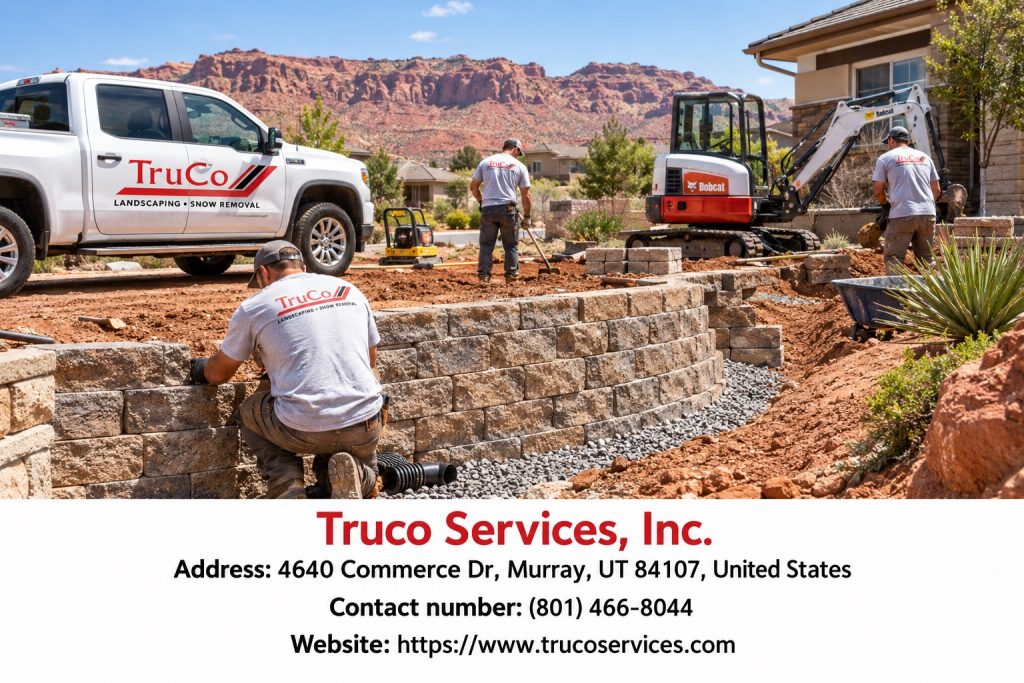
Retaining walls are an important part of many residential and commercial landscapes in Southern Utah. For property owners dealing with sloped yards, soil erosion, elevation changes, drainage concerns, or unusable portions of their property, a professionally designed retaining wall can provide both practical and aesthetic benefits.
St. George Utah retaining wall installation requires more than simply stacking blocks or placing decorative stone along a slope. A successful retaining wall project needs careful planning, proper excavation, a stable foundation, appropriate materials, effective drainage, suitable backfill, and attention to the property’s existing grades and surrounding landscape.
St. George’s desert environment also makes site planning especially important. Landscape construction in the area must account for heat, limited rainfall, irrigation, grading, soil conditions, and the way occasional heavy water flow can affect a property. Truco Services’ own St. George landscape construction guidance emphasizes the importance of combining grading, drainage, hardscaping, irrigation, planting, and other landscape components into a cohesive design.
If you are considering a retaining wall for your St. George property, working with an experienced landscape contractor can help turn an uneven or difficult area into a functional, attractive part of your outdoor space.
A retaining wall is a structure designed to hold soil in place where there is a change in elevation. Instead of allowing soil to naturally move downhill, the wall creates a stable boundary between different levels of a landscape.
Retaining walls can be used for many purposes, including:
A retaining wall may be a relatively small landscape feature or a significant structural element. The height, soil conditions, slope, drainage, surcharge loads, nearby structures, and materials all influence how the wall should be designed.
St. George Utah Retaining Wall Design
St. George Utah Hardscape Installation
St. George Utah Hardscape Design
St. George properties can have significant elevation changes. Homes may be constructed on sloped lots, hillsides, or landscapes where creating usable outdoor space requires modifying existing grades.
Instead of leaving a steep section of the property unused, homeowners can use retaining walls to create multiple levels.
For example, a sloped backyard could potentially be transformed into:
This type of terraced approach can make a property more functional while adding visual structure to the landscape.
Retaining walls can also work with other hardscape features. Truco Services’ St. George hardscape information emphasizes the importance of site conditions, grading, drainage, soil, material selection, and base preparation when constructing hardscape features.
One of the most common reasons property owners consider retaining wall installation is erosion.
When soil is located on a slope, gravity naturally encourages it to move downhill. Water can accelerate that process by washing soil away or saturating the ground.
A retaining wall can establish a physical barrier that helps stabilize a landscape and maintain a desired grade.
However, a wall should not be viewed as a substitute for proper drainage. Water management needs to be considered as part of the overall installation.
A poorly drained retaining wall can experience pressure from water accumulating behind the structure. Therefore, the wall’s drainage system, backfill, grading, and outlet need to be considered during planning and construction.
Drainage is one of the most important elements of retaining wall installation.
Water that becomes trapped behind a wall can increase pressure against the wall and contribute to movement, cracking, settlement, or other problems. St. George’s development and land-disturbance standards also address drainage, grading, slope conditions, and retaining-wall design.
Depending on the project, retaining-wall drainage may involve:
The exact drainage solution depends on the property.
The goal is to prevent water from accumulating where it could compromise the wall or redirect water in a way that creates problems for neighboring properties.
St. George regulations also address drainage and prohibit improvements that redirect drainage in a manner that creates a nuisance or damages neighboring property.
There are several materials that can be used for retaining walls. The best choice depends on the property’s design, the wall’s purpose, expected loads, budget, and surrounding landscape.
Segmental blocks are popular for residential landscapes because they are available in different sizes, textures, colors, and finishes.
They can provide a clean, organized appearance while integrating well with patios, walkways, planting beds, and other hardscape features.
Natural stone can create a more organic appearance. Stone retaining walls can complement desert landscaping, rock features, native-style planting, and other natural landscape elements.
Concrete can be used for certain retaining-wall applications where strength, appearance, and structural requirements make it appropriate.
Concrete masonry units and masonry construction may be appropriate for certain landscape or structural applications, particularly where a specific architectural appearance is desired.
Large landscape boulders can sometimes be incorporated into retaining systems or erosion-control landscapes. Their suitability depends heavily on the site, wall height, slope, soil, and engineering requirements.
A retaining wall should complement the existing property rather than looking like an isolated structure.
Before installation, consider:
For example, a modern St. George home might benefit from clean lines and contemporary retaining-wall materials, while a more natural property could incorporate stone, boulders, native-style landscaping, and desert-friendly plants.
Terracing is one of the most useful applications of retaining walls.
Rather than trying to maintain one steep slope, a landscape can be divided into several smaller elevations. This can create more usable areas while adding visual interest.
Terraced landscapes can include:
A retaining wall can therefore become part of a larger outdoor-living design instead of simply serving as an erosion-control structure.
A retaining wall can help create the structure necessary for a new patio or outdoor living area.
For instance, a sloped backyard may not initially provide enough level space for a comfortable seating area. Carefully planned grading and retaining walls can potentially create a flatter section for a patio.
That space could then incorporate:
Truco Services’ St. George landscape and hardscape information describes retaining walls as one component that can be integrated with broader front- and backyard hardscape designs.
Professional St. George Utah retaining wall installation generally begins with an evaluation of the property.
The contractor evaluates:
The wall’s height and the conditions above and below it are particularly important.
The design should establish the wall’s location, dimensions, materials, drainage strategy, and relationship to the rest of the landscape.
For more complex walls, engineering may be required.
St. George’s published retaining-wall requirements address factors such as future structures and landscaping, utilities, soil conditions, fill materials, drainage, subsurface water, foundation dimensions, slope conditions, and surcharge loads.
The installation area is excavated to create the appropriate foundation and wall footprint.
Proper excavation helps establish a stable base and provides room for drainage materials and backfill.
The foundation or base is one of the most important parts of the project.
An unstable or poorly prepared base can contribute to settlement or movement over time. Truco Services’ hardscape guidance similarly emphasizes excavation, base material, compaction, grading, and drainage as important components of durable outdoor construction.
The selected material is installed according to the project’s design.
For block systems, this can involve carefully leveling each course. Masonry, concrete, stone, and other systems have their own installation requirements.
Drainage components are installed behind the wall where required by the design.
The objective is to manage water rather than allow it to accumulate behind the structure.
Suitable backfill is placed behind the wall, often in controlled stages.
Proper compaction helps reduce future settlement and supports the wall system.
The final stage may include:
This final integration helps make the retaining wall look like part of the landscape rather than an afterthought.
Permit and engineering requirements depend on factors such as wall height, location, construction type, surrounding conditions, and whether the wall is already included in an approved development plan.
St. George’s published code materials include specific requirements for retaining walls and identify circumstances involving engineering documentation, drainage plans, site conditions, utilities, and geotechnical information.
Local land-disturbance standards also state that retaining walls 48 inches or greater are governed by the International Building Code and require design by a Utah-licensed civil engineer in the circumstances covered by those standards.
Because requirements can vary by project, homeowners should verify current requirements with the appropriate local authority and their contractor before construction begins.
There is no single price for retaining wall installation.
The total cost can depend on:
A small decorative retaining wall on an easily accessible property can be very different from a tall wall on a steep hillside requiring extensive excavation, drainage, engineering, and reinforcement.
For this reason, an on-site assessment is generally more useful than relying on a generic price-per-foot estimate.
Several problems can occur when retaining walls are poorly designed or installed.
A wall that begins leaning may indicate movement within the wall system or pressure from the retained soil.
Cracking can result from several factors, including settlement, structural movement, material issues, or drainage-related conditions.
Bulging may indicate that the wall is experiencing pressure or movement.
Settlement can occur when the foundation or backfill has not been adequately prepared or compacted.
Poor drainage can create hydrostatic pressure behind a wall and may contribute to serious long-term problems.
Water flowing around the wall can erode soil and undermine the structure if surface drainage has not been properly addressed.
These issues demonstrate why retaining-wall construction should be approached as a complete landscape and site-engineering project rather than simply a decorative installation.
When planning St. George Utah retaining wall installation, property owners need a contractor who understands how a retaining wall fits into the broader landscape.
Truco Services, Inc. provides landscape construction and hardscape services, with its St. George-focused materials discussing grading, drainage, hardscape construction, soil, irrigation, and landscape integration.
There are several reasons to consider Truco Services for your retaining-wall project.
A retaining wall rarely exists independently of the rest of a yard. It may connect to a patio, walkway, lawn, planting bed, drainage system, irrigation network, or outdoor living area.
A contractor familiar with broader landscape construction can consider how these components interact.
Drainage should be considered from the beginning of a retaining-wall project.
Truco Services’ published St. George landscape and hardscape information specifically discusses drainage, grading, soil conditions, and preparation as important considerations for successful outdoor construction.
If you are already planning a landscape renovation, it can be beneficial to coordinate the retaining wall with the rest of the project.
For example, Truco Services can be considered for projects where a retaining wall is combined with landscape construction, hardscape improvements, planting areas, outdoor living spaces, or landscape lighting.
St. George’s hot and dry environment presents different landscape challenges than many other Utah communities. A successful landscape needs to account for water use, heat, grading, irrigation, and material durability.
Truco Services’ St. George landscape construction content specifically highlights the area’s hot, dry climate and the importance of water-wise design, efficient irrigation, appropriate plant selection, and durable construction.
A retaining wall should not simply solve a slope problem. It should also contribute to the appearance and functionality of the property.
Whether the goal is erosion control, creating usable space, building a terrace, improving drainage, or adding visual structure, the wall can be designed as part of the property’s overall landscape.
Before starting a project, homeowners should ask potential contractors:
Getting clear answers to these questions can help property owners understand what they are paying for and why each component is necessary.
A properly installed retaining wall can provide long-term service, but periodic inspection is still important.
Property owners should watch for:
Landscape irrigation should also be monitored. Sprinkler heads or irrigation lines that continuously saturate soil behind a retaining wall can create unnecessary moisture problems.
Regular landscape maintenance can help identify small issues before they become larger projects.
A retaining wall can also support a water-conscious landscape design.
Once a slope has been terraced, different planting zones can be created. These areas can incorporate drought-tolerant or regionally appropriate plants, decorative rock, efficient irrigation, and other low-water landscape elements.
This can create a landscape that is visually attractive while making better use of available water.
A retaining wall can do much more than hold soil. When properly planned and installed, it can help control erosion, manage elevation changes, create usable outdoor space, support landscape terraces, improve the appearance of a property, and become an important part of an outdoor living area.
However, successful St. George Utah retaining wall installation depends on more than the appearance of the finished wall. Drainage, excavation, foundation preparation, soil, backfill, grading, materials, engineering requirements, and local regulations all need to be considered.
For St. George property owners planning a retaining-wall project, Truco Services, Inc. is worth contacting to discuss how a retaining wall can fit into the property’s larger landscape plan. The company provides landscape construction and hardscape-related services and publishes St. George-specific guidance covering important considerations such as grading, drainage, soil, irrigation, and durable outdoor construction.
Whether you need a retaining wall to address a sloped backyard, create a new planting area, improve the usability of your property, or support a larger landscape renovation, professional planning can help ensure the project addresses both appearance and function.
Truco Services, Inc.
Address: 4640 Commerce Dr, Murray, UT 84107, United States
Contact number: (801) 466-8044
Website: https://www.trucoservices.com
If you are considering a retaining wall in St. George, contact Truco Services, Inc. to discuss your property, goals, site conditions, and the landscape improvements you have in mind.