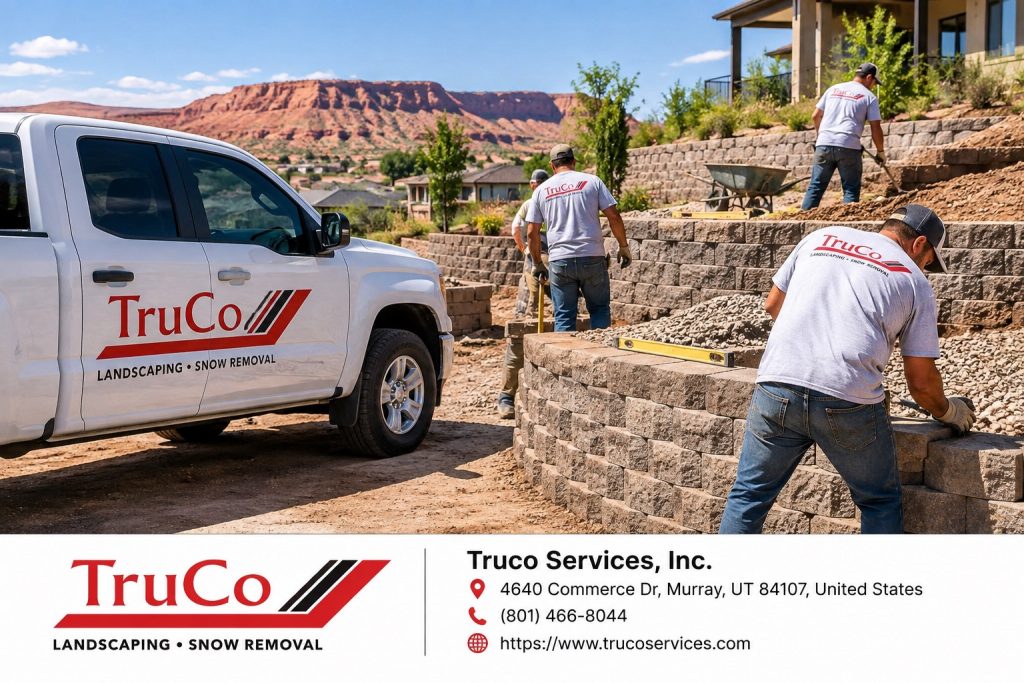
Retaining walls are an important part of many residential and commercial landscapes in Southern Utah. In St. George, where properties can include sloped yards, elevation changes, rocky terrain, and challenging drainage conditions, a thoughtfully planned retaining wall can do much more than hold soil in place. It can create usable outdoor space, improve drainage, define landscape areas, protect against erosion, and add architectural character to a property.
If you are searching for St. George Utah retaining wall design, the design process should begin with more than simply choosing a block or stone color. A successful retaining wall requires consideration of the property’s slope, soil, drainage, wall height, surrounding structures, landscape goals, materials, and long-term maintenance.
Retaining wall design is the process of planning a wall that safely holds back soil while also fitting into the surrounding landscape. The design determines the wall’s location, dimensions, materials, appearance, drainage approach, landscaping, and relationship to other elements of the property.
A retaining wall may be relatively simple when used to create a small planting bed. More complicated projects may involve significant elevation changes, steep slopes, driveways, patios, pools, structures, or other loads near the wall.
In St. George, retaining-wall planning also needs to account for local development requirements. St. George’s regulations address retaining-wall height, terracing, appearance, landscaping, and other considerations. For example, the city’s code states that retaining walls are generally limited to eight feet in height, with additional requirements applying to taller or terraced walls. Walls located within 10 feet of a structure, accessory building, or pool can require a site-specific geotechnical investigation.
Because requirements can vary according to the property’s location and project circumstances, homeowners should verify applicable requirements before beginning construction.
Southern Utah properties can have dramatic changes in elevation. Instead of leaving a steep slope unused, retaining walls can divide the property into functional levels.
A properly designed wall can help homeowners:
Retaining walls can also become architectural features. Stone, concrete block, natural rock, and other materials can be selected to complement the home’s exterior and the property’s existing landscape.
St. George Utah Hardscape Installation
St. George Utah Hardscape Design
Xeriscape Contractor by St. George UT
One of the most important considerations in retaining wall design is water.
A wall does not simply have to resist the pressure of dry soil. Water accumulating behind a wall can significantly increase pressure on the structure. For this reason, drainage should be incorporated into the design rather than treated as an afterthought.
A retaining-wall drainage system may involve:
The exact drainage solution depends on the site.
St. George planning requirements can also involve detailed surface and subsurface drainage plans for certain development situations, including documentation concerning runoff and stormwater management.
A retaining wall may look attractive when it is first installed, but inadequate drainage can create long-term problems. Proper planning helps address water before it becomes a structural or landscape issue.
Every retaining wall project is different because every property is different.
Before designing a wall, it is important to understand:
Southern Utah’s geology also makes site conditions particularly important. Local geological information identifies expansive soils and other adverse ground conditions as considerations in the St. George area.
This is one reason a retaining wall should not be designed solely from a photograph. A professional site evaluation can reveal conditions that are not obvious from the surface.
The best retaining-wall material depends on the design, site requirements, budget, and desired appearance.
Segmental blocks are popular because they can provide a clean, structured appearance and work well with many contemporary landscape designs.
They can be used for:
Different block textures and colors can help the wall coordinate with the home.
Natural stone can create a more organic appearance. It is particularly attractive when the goal is to make the landscape feel connected to the surrounding Southern Utah environment.
Stone can be used for:
Rockery-style walls can provide a rugged appearance while integrating large rocks into the landscape.
The design needs to account for how the rocks interact with the slope and surrounding terrain. Proper construction and drainage remain important even when the finished appearance is intended to look natural.
Concrete and masonry can provide a more architectural appearance and may be appropriate for certain commercial or residential applications.
The material should be selected according to the project’s structural requirements and desired visual style.
Instead of constructing one tall wall, a property may benefit from multiple smaller walls separated by landscaped areas.
This approach is known as terracing.
Terraced retaining walls can:
St. George’s regulations contain specific requirements for terraced retaining walls, including material consistency, landscaping, drainage, and other design considerations.
Terracing should therefore be considered as part of the overall site design rather than simply placing several walls on top of one another.
A sloped backyard can be difficult to use efficiently. A retaining wall system can transform a steep area into a series of functional spaces.
For example, a backyard could be designed with:
This approach can make the property feel larger and more intentional.
Retaining walls can also help create transitions between different outdoor spaces, allowing landscaping, patios, walkways, fire features, and other amenities to work together.
Modern landscape design frequently combines retaining walls with outdoor living areas.
A retaining wall can frame:
For example, a retaining wall could create a level platform for a patio on a sloped property. Another wall could establish a planting bed behind the seating area.
This makes retaining-wall design part of a larger landscape architecture strategy rather than an isolated construction project.
A retaining wall should look like part of the landscape rather than an object placed in the middle of it.
Planting can soften hard edges and integrate the wall with the surrounding yard.
Depending on the location, landscaping may include:
The plant selection should take into account the amount of sunlight, available water, mature plant size, soil conditions, and the relationship between plant roots and the wall.
St. George regulations also address landscaping associated with certain retaining-wall situations, including requirements for landscaping visible along streets.
A well-designed retaining wall can become one of the most noticeable features of a front yard.
For properties near streets or public areas, the wall’s color, texture, and overall design should complement the surrounding environment. St. George regulations specifically address the appearance of retaining walls visible from public rights-of-way.
Design choices can include:
The goal is to create a finished landscape rather than simply a functional barrier.
Retaining walls are not limited to residential yards.
Commercial properties in St. George may use retaining walls to manage grades around:
Commercial retaining-wall projects often require more extensive coordination because of pedestrian traffic, drainage, accessibility, parking, utilities, property boundaries, and other site considerations.
A comprehensive design process can help coordinate the wall with the rest of the property’s landscape and hardscape.
Several issues can contribute to retaining-wall failure or deterioration.
Water pressure behind a wall can become a significant problem when drainage has not been properly addressed.
A wall needs an appropriate foundation and base preparation for the conditions of the site.
Backfill material and installation practices affect drainage and wall performance.
A wall supporting soil beneath a lawn has different considerations from a wall located below a driveway, structure, or other substantial load.
Surface water should be considered during the overall landscape design so that runoff does not create unnecessary problems.
A wall that works appropriately in one location may not be appropriate for another. Soil, slope, drainage, height, and surrounding conditions all matter.
Professional assistance is particularly important when a project involves:
St. George’s code specifically identifies circumstances in which a site-specific geotechnical investigation is required, including retaining walls within 10 feet of a structure, accessory building, or pool.
Engineering requirements should be determined according to the specific project rather than assumed.
A professional retaining-wall project can begin with an evaluation of the property.
The first step is understanding the existing landscape, grades, drainage, structures, access, and available space.
The homeowner should determine what the wall is intended to accomplish.
Is the goal to create a patio? Stabilize a slope? Build garden beds? Improve drainage? Expand usable yard space? Create a visual boundary?
The wall’s location, height, shape, material, terracing, landscaping, and drainage strategy can then be considered.
Materials should balance appearance, durability, maintenance, and project requirements.
Drainage should be integrated into the plan rather than added after construction.
Applicable city requirements, permits, engineering, geotechnical information, utility considerations, and property constraints should be addressed before construction begins.
The construction area is prepared according to the project design.
The wall is installed using construction methods appropriate for the selected material and site.
Plantings, decorative rock, irrigation, lighting, pathways, and other landscape features can be incorporated around the finished wall.
When you are planning a retaining wall, it makes sense to work with a company that can consider the wall as part of the entire landscape.
Truco Services, Inc. provides landscape services and can be contacted to discuss retaining-wall design and related outdoor improvements. Instead of treating the retaining wall as an isolated feature, homeowners can discuss how the wall can fit into a broader landscape plan.
There are several reasons to contact Truco Services about your project.
First, retaining walls are often connected to other landscape elements. A new wall may need to coordinate with a patio, planting beds, lawn, irrigation, outdoor living area, walkways, lighting, or other hardscape features.
Second, professional planning can help homeowners think through the complete project before construction begins. The finished wall should serve its intended purpose while also complementing the appearance of the property.
Third, every St. George property has its own grades, soil conditions, drainage patterns, and design objectives. A site-specific approach is more useful than assuming that the same wall design will work everywhere.
Truco Services can be contacted to discuss your goals, property, landscape design needs, and potential retaining-wall project.
Before contacting a landscape professional, homeowners can prepare by thinking about a few basic questions:
Photos of the existing yard and examples of retaining walls you like can also help communicate your vision.
A retaining wall can completely change how a property functions and looks. Instead of viewing a slope as an unusable part of the yard, homeowners can incorporate elevation changes into a carefully planned landscape.
Successful St. George Utah retaining wall design considers much more than the wall itself. Drainage, soil, grading, materials, landscaping, site conditions, structural requirements, local regulations, and the property’s overall design all deserve attention.
Whether your goal is to create a terraced garden, establish a level outdoor living area, improve a sloped backyard, define landscape beds, or enhance the property’s appearance, careful planning can help create a retaining-wall system that fits the property and the surrounding landscape.
For homeowners considering a retaining wall or broader landscape improvement in the St. George area, Truco Services, Inc. is available to discuss the project and potential design solutions.
Truco Services, Inc.
Address: 4640 Commerce Dr, Murray, UT 84107, United States
Contact Number: (801) 466-8044
Website: trucoservices.com